

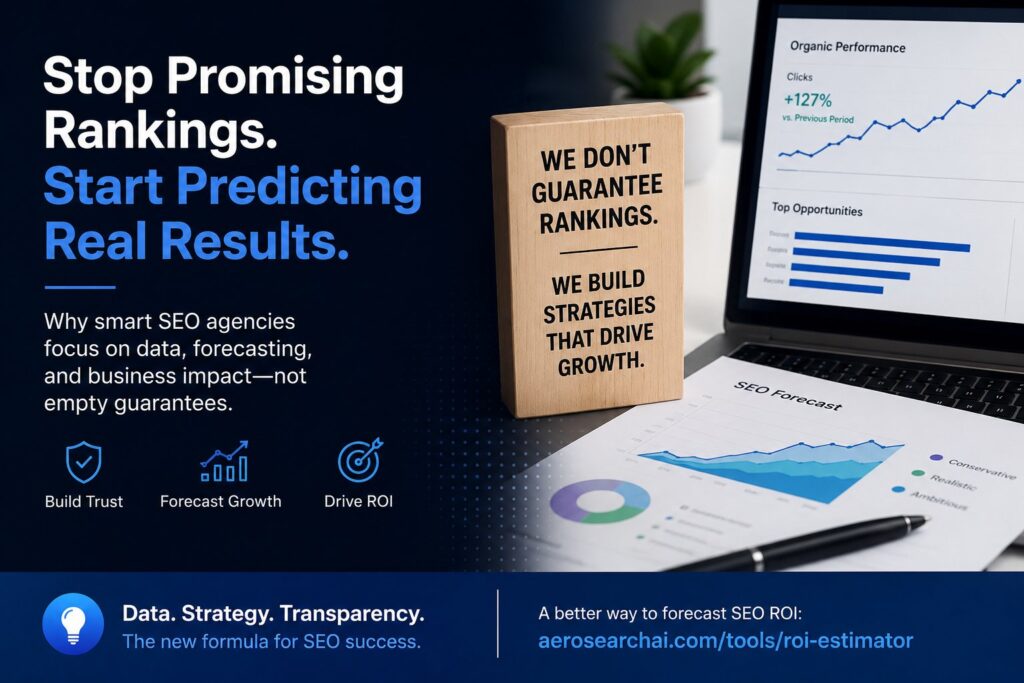
For years, SEO agencies sold a relatively simple promise:
“We’ll get you higher rankings and more traffic.”
And for a long time, that pitch worked.
Clients associated SEO success with ranking #1 for a few keywords, and agencies built proposals around predictable ranking improvements. The search landscape was simpler, Google’s results pages were less crowded, and businesses had fewer ways to measure digital performance.
But modern SEO no longer works that way.
Today’s search environment is shaped by:
- AI Overviews,
- zero-click search results,
- dynamic SERP features,
- personalized search experiences,
- rapidly changing user behavior,
- and increasingly volatile algorithm updates.
Even Google itself repeatedly emphasizes that nobody can guarantee rankings because search results are generated algorithmically and constantly evolve over time. Google’s guidance on people-first content and search quality
As a result, many experienced SEO agencies are moving away from promising:
- guaranteed rankings,
- fixed traffic growth,
- or unrealistic timelines.
Not because SEO no longer works.
But because the smartest agencies now understand something most clients are only beginning to realize:
Modern SEO is probabilistic — not predictable.
And ironically, being honest about that uncertainty often helps agencies close better clients.
The SEO Industry Has a Trust Problem
One of the biggest challenges agencies face today is not competition.
It’s skepticism.
Business owners have spent years hearing promises like:
- “We guarantee page-one rankings.”
- “Traffic will double in 90 days.”
- “You’ll dominate Google.”
Some have already hired agencies that overpromised and underdelivered. Others have watched rankings fluctuate overnight after algorithm updates. Many have seen traffic rise without any meaningful increase in leads or revenue.
So when a new agency comes in promising “more traffic,” most experienced clients immediately ask:
“How realistic is this actually?”
And honestly, that’s a fair question.
Because traffic alone is not a business outcome.
A website can generate thousands of additional visitors and still fail to:
- increase conversions,
- improve lead quality,
- drive sales,
- or produce meaningful ROI.
That’s why experienced agencies increasingly avoid selling SEO as a rankings game.
Instead, they position SEO as a long-term business growth strategy backed by data, forecasting, and realistic expectations.
Why Rankings Alone No Longer Mean Much
A #1 ranking sounds impressive in a proposal.
But rankings without context are often meaningless.
A keyword may:
- have low commercial intent,
- produce weak conversion rates,
- trigger AI-generated summaries,
- or generate very few clicks despite high visibility.
Google Search Console data increasingly reveals this disconnect between rankings and actual traffic behavior.
Google itself separates:
- impressions,
- clicks,
- CTR,
- and average position
because visibility does not automatically translate into engagement. Google Search Console performance report documentation
This is becoming even more important in the AI search era.
Many websites are now experiencing situations where:
- impressions increase,
- rankings remain stable,
- but actual clicks decline.
This trend has been widely discussed across the SEO industry as AI Overviews and expanded SERP features reduce traditional click-through behavior. Discussion on rising impressions but declining clicks in Google Search Console
That’s why sophisticated agencies no longer treat rankings as the primary success metric.
Because business growth depends on much more than visibility alone.
Smart SEO Agencies Focus on Business Outcomes Instead
The best agencies today are shifting the conversation away from:
- vanity metrics,
- isolated keyword rankings,
- and generic traffic promises.
Instead, they focus on:
- revenue potential,
- lead generation,
- opportunity analysis,
- conversion improvement,
- and long-term organic growth.
This fundamentally changes how SEO is sold.
Rather than saying:
“We’ll rank you #1.”
The conversation becomes:
“Here’s where your site is already showing potential, what opportunities exist, and what realistic growth could look like over time.”
That approach feels far more strategic to serious clients.
And more importantly — it builds trust.
Why Smart Agencies Use Forecasting Instead of Guarantees
Experienced agencies understand that SEO outcomes depend on many variables outside direct agency control.
These include:
- algorithm updates,
- competitor activity,
- changing search intent,
- website quality,
- content effectiveness,
- conversion infrastructure,
- and broader market conditions.
Even well-executed campaigns can experience volatility.
That’s why modern SEO forecasting is no longer about certainty.
It’s about probability.
The goal is not to promise exact results.
The goal is to reduce uncertainty using real data.
That distinction matters enormously.
Especially when pitching higher-value SEO retainers.
What Data-Driven SEO Forecasting Actually Looks Like
Most low-quality SEO proposals rely on:
- generic audit exports,
- unrealistic growth assumptions,
- or static ROI calculators disconnected from real website performance.
Smart agencies take a very different approach.
They analyze multiple layers of information before estimating potential outcomes.
Existing Organic Visibility
Google Search Console often reveals hidden opportunities many businesses are completely unaware of.
For example:
- pages ranking just outside page one,
- high-impression keywords with poor CTR,
- under-optimized content,
- or pages already generating partial visibility.
These “striking distance” opportunities are often far more realistic than chasing entirely new rankings from scratch.
Technical SEO Weaknesses
Strong agencies also evaluate technical limitations that may be suppressing growth, including:
- crawlability issues,
- internal linking problems,
- indexing inefficiencies,
- weak content structure,
- or slow page performance.
Because sometimes the fastest traffic gains come from fixing what already exists — not creating endless new content.
Business Metrics & Conversion Potential
A traffic increase means very different things depending on the business.
A local law firm, SaaS platform, affiliate blog, and ecommerce store all monetize traffic differently.
That’s why sophisticated agencies evaluate:
- conversion rates,
- average deal size,
- customer lifetime value,
- lead quality,
- and monetization models
before discussing ROI projections.
This creates far more realistic conversations around growth expectations.
Why Scenario-Based Forecasting Builds More Trust
One of the biggest mistakes agencies make is presenting SEO outcomes as certainty.
Modern clients are too informed for that.
Smart agencies instead use scenario-based forecasting.
This usually includes:
- conservative projections,
- realistic growth scenarios,
- and ambitious upside potential.
Immediately, the conversation feels more credible.
Because uncertainty is acknowledged instead of hidden.
This also helps clients understand an important truth about SEO:
SEO compounds gradually.
The first few months are often foundational:
- technical fixes,
- content optimization,
- internal linking improvements,
- authority building,
- and indexation refinement.
The strongest traffic gains often appear later as these improvements accumulate over time.
When agencies explain this clearly, client expectations become healthier from the start.
And healthier expectations usually lead to:
- better retention,
- fewer disputes,
- and stronger long-term relationships.
Why Generic SEO Audits Are Becoming Less Effective
Most business owners have seen automated SEO audits before.
And honestly, many of them look identical.
Pages filled with:
- technical warnings,
- SEO scores,
- broken links,
- and generic recommendations
rarely answer the one question clients actually care about:
“What does this mean for my business?”
This is why agencies increasingly struggle to differentiate themselves using audits alone.
A technical issue list without business context feels incomplete.
Clients want to understand:
- where the real growth opportunity exists,
- what improvements matter most,
- what realistic outcomes may look like,
- and whether the investment makes financial sense.
That’s why many modern agencies are moving toward SEO forecasting and opportunity modeling instead of relying purely on static audits.
The Growing Role of AI in SEO Forecasting
As SEO data becomes more complex, many agencies are beginning to use AI-assisted forecasting workflows to combine:
- Search Console insights,
- technical SEO audits,
- keyword visibility data,
- traffic trends,
- and business metrics together.
This creates more contextual and realistic projections compared to generic SEO calculators.
For example, tools like SEO ROI Estimator allow agencies and freelancers to generate AI-powered SEO ROI forecasts using:
- Google Search Console data,
- website audit findings,
- and custom business information.
The platform can also generate fully white-labeled PDF reports branded with:
- agency logos,
- company names,
- and website URLs,
making them useful for proposal presentations and client communication.
The real value of these systems is not replacing strategy.
It’s improving clarity.
Because the agencies that communicate SEO opportunities most effectively are often the ones that build the strongest trust with clients.
Helpful Communication Is Becoming a Competitive Advantage
Google increasingly rewards content that is genuinely helpful, transparent, and people-focused rather than purely optimized for rankings. Google’s helpful content guidelines
Interestingly, the same principle now applies to SEO sales itself.
Clients are becoming more skeptical of:
- exaggerated claims,
- guaranteed rankings,
- and unrealistic timelines.
The agencies standing out today are usually the ones willing to communicate:
- uncertainty honestly,
- opportunities realistically,
- and timelines transparently.
Because experienced clients no longer expect certainty.
They expect credibility.
Smart SEO Agencies Sell Confidence — Not Guarantees
The best SEO agencies understand that sustainable client relationships are built on:
- trust,
- transparency,
- realistic expectations,
- and strategic communication.
Not inflated promises.
Modern SEO is simply too dynamic for guarantees to remain credible.
But that doesn’t mean forecasting is impossible.
It simply means forecasting must be:
- evidence-based,
- contextual,
- and grounded in real search data.
And increasingly, the agencies that communicate SEO this way are the ones:
- attracting better clients,
- justifying higher retainers,
- reducing churn,
- and building stronger long-term reputations.
