

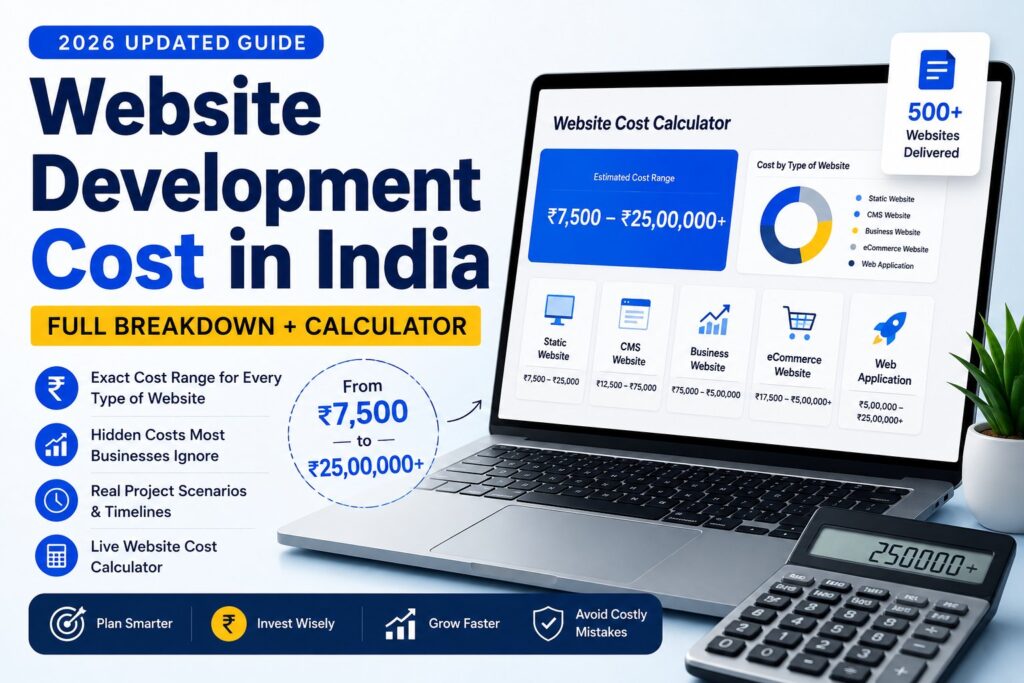
A website in India can cost ₹7,500. The same kind of website can also cost ₹5,00,000. Both numbers are real, because they’re not describing the same thing.
Having a website isn’t optional anymore either way. Clutch’s 2025 survey of small business owners found that 83% of small businesses now have a website, up from 64% in 2018. The real question isn’t whether to build one, it’s what to spend and why.
If you’ve been comparing quotes, you’ve probably seen a freelancer quote ₹15,000, an agency quote ₹1.2 lakh, and a product studio quote ₹10 lakh for what sounds like the same project. Here’s what actually separates those numbers, and how to figure out which range fits your business.
Website Development and Design Cost in India
Website development in India typically falls between ₹7,500 and ₹25,00,000+. The spread is this wide because cost depends on website type, feature depth, customization, and who’s building it, not on page count alone.
| Website Type | Typical Cost (INR) | Approx. USD* | Timeline | Best For |
|---|---|---|---|---|
| Basic static website (4-5 pages) | ₹7,500 – ₹25,000 | $80 – $265 | 1-2 weeks | Portfolios, digital visiting cards |
| Small business CMS website | ₹12,500 – ₹75,000 | $130 – $790 | 2-4 weeks | Service businesses, consultants, clinics |
| Professional custom business website | ₹75,000 – ₹5,00,000 | $790 – $5,260 | 4-8 weeks | Growing brands, multi-location businesses |
| Basic eCommerce store | ₹17,500 – ₹1,25,000 | $185 – $1,315 | 3-6 weeks | Small online stores, under 100 products |
| Advanced eCommerce platform | ₹1,25,000 – ₹5,00,000+ | $1,315 – $5,260+ | 6-12 weeks | Scaling brands, large catalogs |
| Custom web application | ₹5,00,000 – ₹25,00,000+ | $5,260 – $26,300+ | 3-6 months | SaaS, marketplaces, booking engines |
*USD figures are approximate at current exchange rates (₹95/$1) and will shift with the market, use them as a rough reference for international comparison, not a fixed quote.
A ₹20,000 website is built for presence. A ₹2,00,000 website is built for growth. Neither is overpriced or a bargain on its own, it depends on which job you need it to do. If you want a number scoped to your own project rather than a range, our website design cost calculator and eCommerce cost calculator build an estimate from your actual requirements.
What Affects Website Making Cost
Design complexity. A template already has its structure built. Custom UI/UX means wireframes, user journey mapping, and design revisions from scratch, which is more hours regardless of page count. Brand identity work, like a proper logo design, factors into this stage too since it shapes the whole visual system the site is built around.
Features. A contact form and image gallery are cheap. Login dashboards, booking systems, payment gateways, CRM integration, and multi-language support each add development, testing, and long-term maintenance load.
Technology stack. WordPress or Shopify reduce build time because most of the structure already exists. That’s a big part of why WordPress still powers roughly 41.5% of all websites globally as of mid-2026, according to W3Techs, even after a recent dip from its 2025 peak. Custom stacks like React, Laravel, or Django require backend architecture and database design from the ground up. For most business websites, a CMS is enough; custom stacks make sense for SaaS or highly specific systems.
Content. Placeholder content is cheap. Professional copywriting, SEO-structured content, product descriptions, and custom photography all add real cost.
SEO and performance. Technical SEO structure, schema markup, and page speed optimization take planning and expertise, and they’re not cosmetic. Google and Deloitte’s joint research found that a 0.1-second improvement in load speed can lift conversions by roughly 8-10%, and Amazon’s own internal testing traced measurable revenue loss to every extra 100 milliseconds of latency. Skip performance and SEO planning at build time and you usually pay more later in ad spend to compensate. Our SEO cost calculator is a reasonable starting point for budgeting that separately.
Scalability. Clean code and flexible database design cost more upfront but avoid a full rebuild when traffic or product count grows.
Who builds it. DIY is cheapest but takes your time and carries the most risk. Freelancers are moderate cost with variable quality and no backup team, typically ₹500-₹1,500 an hour depending on experience. Agencies cost more because you’re paying for a structured team (design, dev, QA, project management) rather than one person’s bandwidth, usually ₹1,000-₹3,000 an hour. For context, Clutch’s own pricing data puts typical US web design agency rates at $100-149 an hour, roughly 8-10 times the Indian agency rate, which is part of why outsourcing to India remains attractive for international clients even before accounting for quality of work.
Hidden Website Making Charges to Budget For
The invoice at launch is rarely the last thing you’ll spend. Recurring costs that agencies don’t always spell out upfront:
- Domain renewal: ₹500 – ₹2,500/year
- Hosting upgrades as traffic grows: ₹1,500/year on shared hosting up to ₹30,000-₹1,00,000+/year on VPS or cloud
- SSL, security, and backups: ₹3,000 – ₹25,000/year for anything beyond basic free SSL
- Premium plugins and licensing: ₹5,000 – ₹50,000/year
- Content creation: ₹1,000 – ₹5,000 per 1,000 words if you’re publishing regularly
- SEO and marketing: ₹8,500 – ₹75,000+/month, this is usually the biggest ongoing line item
- Maintenance retainers: ₹5,000 – ₹30,000/month
- Redesigns: most business sites need one every 3-5 years as design standards and user expectations shift
The real formula is development cost plus infrastructure, maintenance, content, and marketing over time, not the one-time build fee alone.
GST and Payment Terms: What Your Website Price List Doesn’t Show
Two things trip up first-time buyers that have nothing to do with the website itself.
GST. Most freelancer and agency quotes in India are exclusive of 18% GST unless stated otherwise. A ₹75,000 quote often becomes ₹88,500 on the final invoice. Always ask whether a number is inclusive or exclusive of tax before comparing two quotes side by side, since a “cheaper” quote that’s tax-exclusive can end up costing more than one that already includes it.
Payment structure. A model worth looking for is a small paid design demo before any real commitment, structured something like: a single-page design demo for ₹4,000 or 10% of the full quote, whichever is higher, then 50% advance once you’ve approved that demo, with the remaining 40% due at project completion, right before handover and launch. This front-loads proof of quality before your bigger payment rather than asking you to trust a portfolio alone, and it’s the structure we use ourselves for this reason. Full payment upfront before you’ve seen a single design draft is a common red flag, covered next. On the other end, a vendor asking for 100% only after launch is unusual too and often means the pricing has padding built in to cover their risk.
DIY vs Freelancer vs Agency: Comparing Web Development Cost in India
| Factor | DIY | Freelancer | Agency |
|---|---|---|---|
| Typical cost | ₹0 – ₹10,000 | ₹10,000 – ₹80,000 | ₹20,000 – ₹5,00,000+ |
| Expertise | Self-taught | Individual skill | Team expertise |
| Scalability | Limited | Moderate | High |
| Support | Self-managed | Limited | Structured |
DIY suits a simple, non-critical presence where you’re willing to invest your own time. A freelancer works well for smaller projects with a moderate budget, though outcomes depend heavily on that one person’s skill. An agency makes sense when the website is core to revenue and you need process, QA, and long-term support rather than just a build. You can see how that plays out on real projects in our portfolio and case studies.
Real Website Building Cost Scenarios for Small Businesses
Local service business (lead generation): ₹25,000 – ₹60,000 typically covers an 8-15 page CMS site, mobile-optimized design, WhatsApp and Maps integration, and basic on-page SEO. This is the sweet spot for gyms, clinics, and solo practitioners who need inquiries, not infrastructure.
Growing or multi-location brand: ₹75,000 – ₹2,50,000 covers custom UI/UX, 20-40 structured pages, CRM integration, and advanced SEO architecture. Costs more because custom layouts and backend integrations take real design and engineering hours, not because it’s “bigger.”
Small eCommerce store: ₹80,000 – ₹2,00,000 covers a product catalog, payment gateway, shipping setup, and customer accounts for a business testing or scaling online sales. Run your own catalog size and feature list through the eCommerce cost calculator for a tighter estimate.
Most businesses fall between ₹30,000 and ₹2,00,000. Only businesses needing serious automation, large-scale eCommerce, or custom software move past that.
Red Flags to Watch For, Regardless of Website Price
A fair price doesn’t guarantee a good outcome. Watch for these regardless of what a vendor quotes:
- No written scope of work. If page count, features, revision rounds, and timeline aren’t in writing before you pay, there’s nothing to hold the project to later.
- No portfolio in a remotely similar industry or scale. A vendor who’s only ever built restaurant sites may not be the right fit for a B2B SaaS site, even at the right price.
- Full payment demanded before any design review. Reputable vendors work in milestones; this shifts all the risk onto you upfront.
- Unusually low quotes with vague inclusions. “Website” with no specifics on pages, features, or what’s excluded is how ₹15,000 quietly becomes ₹45,000 once “extras” start getting billed.
- No mention of who owns the domain, hosting, and code after delivery. If this isn’t addressed unprompted, ask directly, see the FAQ below.
- Communication that goes quiet after the advance is paid. A slow response after the deposit clears is one of the most consistent early warning signs clients report.
None of these are about price. A ₹2,00,000 agency can show every one of these red flags just as easily as a ₹15,000 freelancer.
How to Lower Your Website Development Pricing Without Cutting Corners
There’s a real difference between a cheap website and a smaller, smarter one. A few ways to genuinely bring the number down without gambling on quality:
Start with an MVP, not the full vision. Launch with the pages and features you need now (core service pages, contact, basic SEO) and add booking systems, member portals, or advanced integrations once the site is actually generating leads. This spreads cost across phases instead of front-loading everything before you know what’s working.
Use CMS platforms instead of custom code where you can. WordPress, Shopify, and similar platforms already have the plumbing built. Reserve custom development for the one or two features that genuinely need it, not the whole site.
Lock your content and requirements before development starts. Changes made after a build has started (a new page, a different feature, a redesigned section) typically cost several times more than including them in the original scope, because they mean redoing work that’s already done, not adding to a blank canvas. Have your text, images, and page list ready before you brief a vendor.
Build a long-term relationship instead of shopping fresh every time. A vendor who already knows your brand, hosting setup, and past decisions works faster and cheaper on the second project than a new one starting from zero, and is more likely to flag problems proactively rather than waiting to be asked.
None of these mean spending less than the job requires. They mean not paying twice for the same work through rework, rebuilds, or starting over with someone new each time.
Is Website Development Cost an Expense or an Investment?
Run the numbers before deciding a quote is “too expensive.” If your average customer is worth ₹25,000, and a website helps you close even one extra customer a month, a ₹1,50,000 website amortized over five years costs about ₹2,500/month, and pays for itself many times over.
The flip side matters too: a cheap website with weak SEO, poor conversion design, and no scalability plan often costs more in the long run through higher ad spend, lost visitors, and an eventual rebuild. The page speed research cited earlier makes the same point from a different angle: slow, poorly built sites lose conversions before a visitor ever reads your content. Cost only becomes “expense” rather than “investment” when there’s no marketing plan, no SEO plan, and no conversion structure behind it, in which case even ₹20,000 is wasted.
Website Cost Isn’t Just About Google Anymore
Most of this guide, and most pricing conversations in general, are framed around traditional Google SEO. That’s still essential, but it’s no longer the only place buyers find businesses. Tools like ChatGPT, Perplexity, and Google’s AI Overviews are increasingly where people ask questions and get direct answers instead of a list of links, and a site that ranks well in classic search isn’t automatically structured to be picked up and cited by those tools.
This doesn’t need to change your budget dramatically, but it’s worth asking whoever builds your site whether they’re thinking about clear, well-structured content, accurate schema markup, and direct, quotable answers to common questions, the same habits that make a page rank well in Google are a reasonable starting point for AI visibility too, but they’re not automatically identical. If this is new territory for your vendor, that’s worth knowing before you commit, not after.
Website Creation Cost by Business Stage: Choosing Your Budget
- Early stage / validating an idea: ₹20,000 – ₹60,000. A clean CMS site, clear service pages, lead forms, basic SEO. Avoid overbuilding here.
- Growth stage / active lead generation: ₹75,000 – ₹2,00,000. Custom UI/UX, conversion-focused pages, CRM integration, content architecture.
- Scale stage / digital infrastructure: ₹2,00,000 – ₹6,00,000+. Custom development, automation, analytics, hosting built for volume.
- Enterprise / software model: ₹5,00,000 – ₹25,00,000+. Full architecture planning, API integrations, security and compliance, ongoing QA.
Frequently Asked Questions About Website Cost in India
Why Do Website Charges Vary So Much for the Same Type of Site?
Because “a website” isn’t a fixed product, it’s a quote for someone’s time. A freelancer working alone at ₹300/hour and a five-person agency team billing for design, development, QA, and project management will land on very different numbers for what sounds like the same brief. The gap usually isn’t padding, it’s how much process and how many people are behind the number. Ask what’s included in the hours quoted, not just the final figure.
Is a ₹5,000-10,000 Website Enough for a Small Business?
For a personal portfolio, a single local service with no competition, or a placeholder while you’re pre-launch, yes. For anything that needs to rank on Google, convert visitors into inquiries, or represent a brand you’re actively marketing, this budget usually means a template with no SEO structure and no room to grow, which often costs more later in the form of a rebuild plus the leads you lost while it underperformed.
How Much Does a Single-Page Website Cost in India?
A genuine single-page site (one scrolling landing page, no separate pages or CMS backend) typically runs ₹5,000 to ₹20,000, cheaper than a multi-page CMS site because there’s no navigation structure or content management to build. It works well for a single product launch, an event, or a personal profile, but it’s a poor fit if you plan to add services, blog content, or SEO pages later since you’ll likely need to rebuild rather than extend it.
Is WordPress Website Development Cost Lower in India?
Usually yes upfront, since the CMS structure already exists and doesn’t need to be coded from scratch. Where the savings can disappear is afterward: premium themes, plugin licenses, security monitoring, and update maintenance add up over a few years in a way a custom-built site sometimes avoids. WordPress is a good default for most business sites, just budget for the ongoing plugin and maintenance side, not only the build.
How Much Does a Website Cost Per Month in India?
Beyond the one-time build cost, a realistic monthly floor is hosting (₹500-3,000), basic maintenance (₹5,000-15,000), and some ongoing SEO or content work if visibility matters to you (₹8,500+). A site with no monthly budget behind it tends to go stale, fall in rankings, and eventually need the same rebuild spend you were trying to avoid.
Freelancer or Agency: Which Is Right for Your Budget?
If the website is a side project or a one-time need with low risk if something goes wrong, a freelancer is a reasonable, cheaper choice. If the website is central to how you get customers, a single freelancer becoming unavailable mid-project or after launch (which happens more often than agencies like to admit) can leave you stuck with no one who knows the codebase. Agencies cost more specifically because there’s a team and a process behind the site, not just one person’s availability.
What’s Included in a Website Package, and What Costs Extra?
Most packages include design, a set number of pages, and basic setup. What’s commonly excluded and billed separately: stock photography or original photography, copywriting, logo design, more than 1-2 rounds of revisions, SEO beyond basic meta tags, and any page added after the scope is locked. Ask for the page count, revision limit, and what “SEO-ready” specifically means before you sign off on a quote.
Do I Own My Website and Its Code After It’s Built?
This depends entirely on your contract, and it’s worth confirming before you pay, not after. Some cheaper builders retain admin access, host the site under their own account, or use page-builder plugins that make it difficult to move the site elsewhere. Ask directly who holds the domain, hosting, and admin login once the project is delivered, and get it in writing.
How Much Does It Cost, and How Long Does It Take, to Build a Website in India?
A basic static or small CMS site typically takes 1-3 weeks. A custom business website with original design and integrations runs 4-8 weeks. eCommerce or custom web applications can take 2-4 months depending on scope. Timelines usually slip on the client side, not the developer’s, through delayed content, image approvals, and feedback rounds, so the fastest way to hit your date is having your content ready before the build starts.
The Bottom Line
There’s no single “website cost” in India, there’s the cost of presence, the cost of growth, and the cost of infrastructure, and they’re different budgets for different jobs. Before you compare quotes, get clear on what role the site needs to play over the next few years. That answer, more than any price list, is what should set your budget.
If you want a quote scoped to your specific business, book a free consultation with our team for a straight answer, not a range.

This is awesome, Ahmed! Website costs can be confusing, so this breakdown is super helpful. Bookmarked for future reference!
While the cost of website development in India can vary depending on your region and the level of service you require, it is usually not too expensive. A good starting point would be to speak with an experienced web designer who can give you a quote based on your specific needs.
Very informative post. Now I know what prices to expect from a freelancer as well as a web design company for my website project. Thanks a ton!