
Starting a digital marketing agency has never been easier.
A domain name, a website, a few software subscriptions, a laptop and access to platforms such as Google, Meta, WordPress, Canva and ChatGPT can be enough to get started. Services can be outsourced, reporting can be automated, content can be generated with AI, and clients can be acquired through marketplaces, social media or direct outreach.
That accessibility has created enormous opportunity.
It has also created an enormous problem.
Almost anyone can become your competitor.
A new agency can appear tomorrow offering SEO for $300 a month. Another can offer website development at a fraction of your price. Someone working from a home office can present themselves as a “full-service digital marketing company.” A freelancer can bundle ten services into one inexpensive package. A white-label provider can allow an agency with almost no delivery infrastructure to appear much larger than it actually is.
Meanwhile, established agencies face a different kind of pressure. They have teams, offices, technology subscriptions and overheads to support. Some have built strong reputations over many years, only to find themselves competing against companies willing to charge dramatically less.
This creates a difficult question:
How does a digital marketing agency build a business that can thrive when the barrier to entry is so low and competitors can continuously undercut prices?
The answer is not to become cheaper.
It is to become harder to compare, harder to copy and harder to replace.
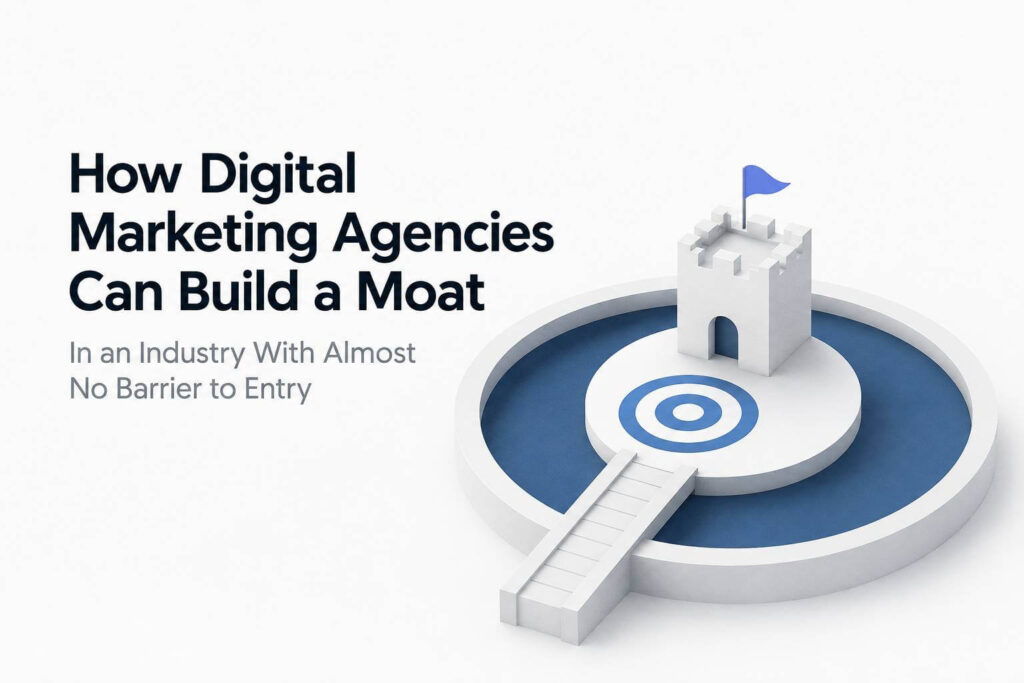
That is what a moat does.
What Is a Moat in a Digital Marketing Agency?
The concept of an economic moat comes from the idea of a defensive advantage that protects a business from competitors.
For a digital marketing agency, a moat is an advantage that becomes difficult, expensive or time-consuming for another agency to reproduce.
A good agency may produce excellent work.
A defensible agency has something more.
It has assets, systems, relationships, knowledge, technology, distribution or reputation that compound over time.
For example, competitors can copy an agency’s service list.
They can copy its pricing.
They can offer SEO, web design, social media marketing and paid advertising.
They can even copy the wording on its website.
What they cannot easily copy is ten years of proprietary data, hundreds of client relationships, a deeply refined methodology, thousands of successful experiments, an established audience, specialized expertise and software built around the agency’s accumulated knowledge.
That distinction is critical.
Service advantage vs. moat
| Competitive advantage | Can competitors copy it? | Long-term strength |
|---|---|---|
| Lower pricing | Very easily | Low |
| More services | Easily | Low |
| More social media posts | Easily | Low |
| Generic AI usage | Very easily | Low |
| Better customer service | Relatively easily | Moderate |
| Industry specialization | Moderately | High |
| Proprietary processes | Moderately | High |
| Strong case-study library | Slowly | High |
| Proprietary software | Difficultly | Very high |
| Proprietary data | Difficultly | Very high |
| Owned audience/community | Difficultly | Very high |
| Strong category reputation | Difficultly | Very high |
| Deep client integrations | Difficultly | Very high |
| Network and ecosystem effects | Very difficultly | Very high |
The objective is not to build every possible moat.
It is to build a combination of advantages that reinforce one another.
Why Digital Marketing Is So Easy to Enter
Digital marketing has an unusual business structure.
A manufacturing company may need factories, equipment, machinery, logistics and significant capital before it can compete.
A traditional media company may need distribution infrastructure.
A software company needs product development and engineering resources.
A digital marketing agency can start with very little physical infrastructure.
Even service delivery has become easier.
Many activities can now be outsourced or automated:
- Website development
- Graphic design
- Content production
- Search engine optimization
- Social media management
- Reporting
- Email marketing
- Lead generation
- Research
- Data analysis
- Customer support
AI has accelerated this trend further.
An individual can now produce work that previously required several people.
That is good for productivity.
But it also means that execution alone is becoming less defensible.
If your competitive advantage is simply that you can produce a blog post, design a social media graphic, build a website or run an SEO campaign, competitors can increasingly replicate the underlying capability.
The question therefore changes from:
“What services do we provide?”
to:
“What assets are we building that become more valuable as we operate?”
The Race to the Bottom Is Usually a Positioning Problem
When agencies are constantly losing clients to cheaper competitors, the instinctive response is often to reduce prices.
This creates a dangerous cycle.
Suppose an agency charges $2,000 for a service and a competitor offers something similar for $1,200.
The agency reduces its price to $1,500.
Another competitor offers it for $800.
The first agency responds again.
Eventually, the company has successfully lowered its own margins without necessarily becoming more attractive to the clients that value quality.
Price competition can be particularly destructive in digital marketing because clients often struggle to distinguish between providers before buying.
To an inexperienced buyer, these two offers can appear identical:
Agency A: SEO package, 20 keywords, monthly reports, $1,500
Agency B: SEO package, 20 keywords, monthly reports, $800
Unless the buyer understands the difference in strategy, execution quality, technical expertise, content quality and expected outcome, the cheaper option naturally looks attractive.
This is where differentiation matters.
Don’t sell what is easy to compare
The easiest things to compare are generally the things that become commodities.
For example:
- Number of keywords
- Number of pages
- Number of social posts
- Number of backlinks
- Number of revisions
- Number of monthly reports
- Number of hours
- Number of deliverables
These metrics are easy to advertise, but they rarely communicate business value.
A stronger agency sells a system, outcome and expertise, not a pile of deliverables.
Instead of:
“We publish 12 SEO articles per month.”
the positioning becomes:
“We build an organic search growth system designed to increase qualified search visibility and commercial leads.”
That is harder to commoditize.
1. Own a Category Instead of Trying to Serve Everyone
One of the strongest and most achievable agency moats is specialization.
There is a major difference between saying:
“We are a digital marketing agency.”
and:
“We are the SEO growth agency for healthcare businesses.”
The second statement immediately establishes a category.
Specialization allows an agency to accumulate knowledge faster because it repeatedly encounters similar problems.
After working with dozens of healthcare companies, for example, an agency may understand:
- Common customer journeys
- Industry-specific search behavior
- Typical compliance restrictions
- High-value keywords
- Content opportunities
- Local search patterns
- Competitive dynamics
- Common technology stacks
- Typical objections during sales
That accumulated knowledge becomes an advantage.
A generalist competitor might be able to offer the same services.
But it starts from zero industry knowledge.
The specialization flywheel
More clients in one category
↓
More industry-specific knowledge
↓
Better processes
↓
Better results
↓
More case studies
↓
Stronger reputation
↓
More inbound demand
↓
More clients in the same category
That is a genuine compounding advantage.
You do not necessarily need one niche forever
Specialization does not mean you must permanently restrict your business to one industry.
An agency can establish authority in one category, build systems around it, and then expand into adjacent markets.
The important thing is to avoid trying to own everything simultaneously.
2. Build a Proprietary Methodology
Most agencies say they have a process.
Few turn that process into intellectual property.
A proprietary methodology is a documented framework for how your agency approaches a particular business problem.
It could be a framework for:
- SEO growth
- Website conversion optimization
- Local search
- AI search visibility
- Content strategy
- B2B lead generation
- Ecommerce growth
- Digital transformation
The methodology itself does not need to be revolutionary.
What matters is that it is:
Consistent, documented, measurable and refined through experience.
Imagine two agencies.
Agency A says:
“We provide SEO services.”
Agency B says:
“Our Organic Growth Framework evaluates technical foundations, search demand, competitive gaps, content opportunities, conversion architecture and authority development before creating a 12-month growth roadmap.”
The second agency has created something that can be named, taught, measured and improved.
Over time, the methodology becomes embedded across:
- Sales
- Strategy
- Delivery
- Training
- Reporting
- Client communication
- Internal quality control
That makes it significantly more difficult to replicate.
And there is another benefit.
A methodology can scale beyond the founder.
If everything exists only inside the founder’s head, the business has key-person risk.
A documented system turns individual expertise into organizational capability.
3. Turn Internal Processes Into Intellectual Property
Not every moat needs to be visible to clients.
Some of the strongest advantages exist behind the scenes.
Consider an agency with years of internally developed:
- Automation scripts
- Reporting systems
- Research templates
- QA checklists
- SEO workflows
- Content briefs
- Keyword classification systems
- AI prompts
- Data pipelines
- Website deployment systems
- Lead qualification rules
- Analytics frameworks
Any individual component may look insignificant.
Collectively, they can make the agency dramatically more efficient.
Suppose Agency A needs 20 hours to complete a campaign setup.
Agency B has automated much of the process and needs only 8 hours.
Agency B can potentially:
- Charge the same price and earn higher margins
- Charge less while maintaining margins
- Deliver faster
- Handle more clients
- Invest more money into strategy
- Spend more time on experimentation
That is an operational moat.
The important principle is:
Don’t just improve your process. Capture the process.
Document it.
Automate it.
Measure it.
Train people on it.
Improve it.
Eventually, it becomes part of the agency’s operating system.
4. Build Proprietary Software Instead of Renting Every Capability
Most agencies depend heavily on third-party platforms.
They use someone else’s:
- SEO software
- CRM
- Analytics tools
- Reporting dashboards
- Project management systems
- AI models
- Research platforms
- Design software
There is nothing wrong with that.
The problem arises when everything you do is available to every competitor for the same subscription price.
If every agency uses the same tools and follows the same workflows, those tools create little differentiation.
This is where proprietary software can become powerful.
It does not necessarily mean building a massive SaaS product.
It could be something much smaller:
- Internal SEO analysis software
- Automated technical audit systems
- AI search visibility monitoring
- Lead-quality scoring
- Competitor intelligence dashboards
- Automated reporting
- Content opportunity identification
- Campaign performance prediction
- Custom client portals
Even small internal tools can produce major competitive advantages.
The real value of proprietary software
The software itself is only one part of the moat.
The bigger advantage comes from the combination of:
Software + agency expertise + proprietary workflows + historical data
That combination can be extremely difficult for another agency to reproduce.
5. Own Data That Competitors Cannot Simply Buy
Data can become one of an agency’s most valuable long-term assets.
Every campaign generates information.
Every website produces observations.
Every experiment creates a result.
Every failed strategy teaches something.
Every successful campaign creates another data point.
Over five or ten years, this can become an enormous knowledge base.
Imagine an agency has worked on hundreds of websites and accumulated data around:
- Keyword growth
- Content performance
- Conversion rates
- Industry benchmarks
- Search trends
- Local search performance
- Landing page behavior
- Lead quality
- SEO timelines
- Technical issues
- Content formats
- Competitive patterns
That data can be transformed into proprietary benchmarks.
For example:
Average organic growth timeline for B2B companies
or:
Search visibility benchmark by industry
or:
AI search visibility benchmark for global businesses
Now the agency isn’t simply providing services.
It is publishing research based on experience that competitors cannot perfectly reproduce.
Data creates a compounding advantage
More clients create more data.
More data creates better insights.
Better insights produce better strategies.
Better strategies produce better results.
Better results attract more clients.
That is another flywheel.
6. Build a Case Study Library That Competitors Cannot Fake
One of the most underestimated agency assets is a deep case-study portfolio.
But there is a big difference between a case study and a testimonial.
A testimonial says:
“Great agency. Highly recommended.”
A useful case study explains:
Where the client started → What was wrong → What was changed → Why it was changed → How long it took → What happened → What the business gained
The best case studies include actual numbers where possible.
For example:
| Metric | Before | After |
|---|---|---|
| Organic clicks | 4,200/month | 11,800/month |
| Qualified leads | 38/month | 97/month |
| Ranking keywords | 620 | 1,940 |
| Conversion rate | 1.8% | 3.2% |
A competitor can copy your service description.
They cannot copy your historical results.
They cannot recreate five years of client outcomes overnight.
That’s why a case-study library gets more valuable as the agency ages.
Your past work becomes part of your competitive infrastructure.
7. Build an Audience You Own
Many agencies spend years trying to rank on Google while ignoring the value of building an audience.
Organic search is valuable.
But depending exclusively on algorithms you do not control is risky.
A stronger agency builds multiple owned or semi-owned distribution channels:
- Email newsletter
- LinkedIn audience
- YouTube audience
- Industry community
- Podcast
- Research publication
- Resource library
- Free tools
- Annual reports
The objective isn’t to become an influencer.
It is to build distribution that compounds.
Imagine two agencies competing for the same client.
Agency A starts cold outreach.
Agency B publishes useful research every month, has thousands of newsletter subscribers, receives regular search traffic, offers free tools and has an established professional audience.
Agency B begins every sales conversation with greater credibility.
That is distribution as a moat.
8. Free Tools Can Become More Than Lead Magnets
Free tools are particularly interesting for digital marketing agencies because they combine several moat characteristics.
A useful free tool can generate:
Traffic
↓
Usage
↓
Data
↓
Brand recognition
↓
Leads
↓
Product feedback
↓
Better technology
↓
More traffic
For example, an agency could develop:
- SEO calculators
- Website cost calculators
- SEO audit tools
- ROI calculators
- AI visibility checkers
- Content tools
- Digital marketing assessment tools
- Lead qualification tools
The mistake is to think of these only as lead magnets.
A properly developed tool can become a distribution asset, data collection system, brand asset and eventually a software product.
That is significantly more valuable.
9. Create Switching Costs by Becoming Embedded in the Client’s Business
A good agency delivers work.
A deeply embedded agency becomes part of how the client operates.
There is a major difference.
If you provide monthly social media posts, replacing you may be relatively straightforward.
But imagine your agency manages:
- CRM integration
- Marketing attribution
- Analytics infrastructure
- Reporting dashboards
- Website systems
- Lead tracking
- Conversion reporting
- Content workflows
- Search strategy
- Internal marketing training
The agency now has institutional knowledge.
Replacing it becomes more complicated.
This creates switching costs.
However, there is an important ethical distinction.
The goal should not be to trap clients.
The goal is to make your agency valuable because replacing you would mean losing expertise, continuity, systems and accumulated knowledge.
The best switching cost is dependence on value, not dependence created through contractual friction.
10. Move From Vendor to Strategic Partner
Agencies are easier to replace when they are treated as vendors.
They become harder to replace when leadership considers them strategic partners.
A vendor receives instructions.
A strategic partner helps determine what the business should do next.
That means moving the conversation from:
“How many posts did you publish?”
to:
“Which channels are producing profitable customers, and where should the company invest next?”
Instead of:
“How many keywords are ranking?”
ask:
“Which search visibility improvements are producing commercial opportunities?”
Instead of:
“Did the campaign hit its KPI?”
ask:
“Did the campaign improve the economics of acquiring a customer?”
This requires understanding the client’s business beyond marketing.
The deeper your understanding becomes, the more difficult it becomes to replace you with an agency that only understands execution.
11. Build Deep Industry Expertise
Technology changes.
Platforms change.
Algorithms change.
Specific tactics become obsolete.
Industry knowledge often lasts much longer.
A digital marketing agency serving a heavily regulated industry, for example, may need to understand:
- Compliance requirements
- Customer behavior
- Purchase cycles
- Industry terminology
- Regulatory restrictions
- Decision-making structures
- Typical sales processes
- Commercial economics
That knowledge creates differentiation.
The same principle applies to B2B, healthcare, SaaS, finance, legal, ecommerce and other specialized markets.
The more specialized the problem, the more valuable specialized expertise becomes.
This is especially powerful in markets where a mistake is expensive.
When a client is choosing an agency to manage a critical growth channel, the cheapest provider is not always the most attractive option.
Risk matters.
12. Build Exclusive Relationships
Relationships can also become moats when they are difficult to reproduce.
Examples include strong relationships with:
- Publishers
- Industry associations
- Creators
- Technology vendors
- Consultants
- Referral partners
- Business communities
- Specialized experts
A single relationship is not necessarily a moat.
A network of relationships can be.
The goal is to build an ecosystem where your agency becomes an important connector.
For example:
Agency → Clients → Partners → Publishers → Experts → Technology providers
The more value that flows through the network, the more defensible the position becomes.
13. Create a Client Ecosystem
There is another opportunity that many agencies overlook.
Your clients themselves can become part of your competitive advantage.
Suppose you have a strong network of companies across complementary industries.
You can facilitate:
- Partnerships
- Referrals
- Joint ventures
- Cross-promotions
- Strategic introductions
- Content collaborations
- Industry events
Now your agency offers something beyond marketing execution.
It offers access to an ecosystem.
Over time, this can create a network effect:
More clients → More connections → More value → Stronger attraction for new clients
That is considerably harder to replicate than adding another service to a website.
14. Use AI as an Advantage, Not as Your Differentiator
Almost every agency can say:
“We use AI.”
That statement has very little differentiation.
Your competitors have access to the same general-purpose models.
The real advantage comes from what you build around AI.
For example:
- Proprietary datasets
- Custom workflows
- Internal agents
- Automated QA
- Brand-specific knowledge bases
- Custom integrations
- Proprietary prompts and evaluation systems
- Human review processes
- Historical campaign intelligence
Think about AI as an infrastructure layer.
The moat isn’t:
“We use AI.”
The moat is:
“We have built an operating system around AI that incorporates years of proprietary data, workflows and expertise.”
That is much more defensible.
15. Don’t Confuse Contracts With Moats
Long-term contracts can improve retention.
Upfront payments can improve cash flow.
Multi-year agreements can provide revenue visibility.
But these aren’t necessarily competitive moats.
A contract may prevent a client from leaving easily.
It does not necessarily prevent a competitor from taking the next client.
This distinction matters because a company can become financially stable without becoming competitively defensible.
A strong business needs both.
Retention mechanisms vs. real moats
| Strategy | Helps retention? | Creates a competitive moat? |
|---|---|---|
| Annual contracts | Yes | Low |
| Early termination fees | Yes | Low |
| Upfront retainers | Yes | Low |
| Discounts | Sometimes | Very low |
| Proprietary technology | Yes | High |
| Proprietary data | Yes | Very high |
| Industry authority | Yes | High |
| Strong network | Yes | High |
| Specialized methodology | Yes | High |
| Deep business integration | Yes | High |
The objective should be to retain clients because leaving would mean giving up something valuable, not merely because leaving is contractually inconvenient.
16. Reduce Your Cost of Delivery Without Becoming a Cheap Agency
Operational efficiency is important.
But there is a difference between:
Cost advantage
and
cheap positioning.
An efficient agency may have:
- Better automation
- Better training
- Better documentation
- Better project management
- Better technology
- Better resource allocation
- Better quality control
That agency can potentially deliver more value at the same price.
It does not have to market itself as the cheapest provider.
This is an important strategic principle:
Use efficiency to improve margins and value. Don’t use efficiency as an excuse to permanently lower your prices.
Higher margins give you the resources to invest in technology, people, research and distribution.
Those investments can eventually create new moats.
17. Build Your Brand Around a Point of View
A brand is more than a logo.
In a crowded market, a strong agency needs a recognizable point of view.
What do you believe about digital marketing that competitors do not communicate clearly?
Perhaps you believe:
- Organic growth compounds
- Vanity metrics are dangerous
- Websites should be business infrastructure, not digital brochures
- SEO should be connected to revenue
- AI search will change how brands build visibility
- Agencies should prioritize long-term growth over short-term tactics
A distinct point of view creates identity.
It gives clients something to remember.
And it makes your content more distinctive.
A generic agency can publish information.
A category leader publishes ideas.
18. Build Reputation Before You Need It
Reputation compounds slowly.
That is precisely why it becomes valuable.
A company that has published useful material for years has an advantage over a competitor that begins publishing tomorrow.
A company with hundreds of credible case studies has an advantage over one with five.
A company with years of industry relationships has an advantage over a newly established firm.
A company known for one specific capability has an advantage over a generalist that claims to do everything.
This creates an uncomfortable reality for new agencies:
You cannot manufacture ten years of reputation overnight.
But you can start building the assets today.
Every successful campaign can become a case study.
Every project can produce data.
Every internal improvement can become process IP.
Every insight can become content.
Every client relationship can become a long-term relationship.
Every useful tool can become a distribution channel.
That’s how the moat starts forming.
The Agency Moat Flywheel
The strongest agency businesses don’t build these advantages independently.
They connect them.
A useful way to think about the model is:
Clients
↓
Data & Experience
↓
Proprietary Insights
↓
Better Methodology
↓
Better Technology & Automation
↓
Better Results
↓
Case Studies & Reputation
↓
More Distribution
↓
More Qualified Clients
↓
More Data & Experience
That is the flywheel.
And it gets stronger with time.
A new competitor can copy the visible parts of your business, but it cannot instantly reproduce the accumulated history underneath them.
What a Defensible Digital Marketing Agency Looks Like
A defensible agency does not necessarily have thousands of employees.
It may actually be relatively small.
What makes it different is the quality and interconnectedness of its assets.
Imagine an agency that has:
Specialization
It dominates a clearly defined category.
Methodology
It has a recognizable and refined way of solving problems.
Technology
It has proprietary tools and automation.
Data
It has years of accumulated performance information.
Case studies
It has deep proof of results.
Distribution
It has an audience, newsletter, community, research or tools.
Relationships
It has a strong ecosystem of clients and partners.
Integration
It is deeply connected to the client’s marketing infrastructure.
Brand
It is known for a specific point of view.
People
It has specialized expertise that is difficult to recruit or replicate.
None of these alone is unbeatable.
Together, they become powerful.
What Should a Small Agency Build First?
Not every agency has the capital to build software, hire specialized teams or create a major media company.
That doesn’t mean a moat is out of reach.
A small agency can start with assets that require more consistency than capital.
A sensible progression could look like this:
| Stage | Priority |
|---|---|
| Stage 1 | Choose a clear market or specialization |
| Stage 2 | Build a documented methodology |
| Stage 3 | Produce exceptional case studies |
| Stage 4 | Develop internal automation and process IP |
| Stage 5 | Build an owned audience |
| Stage 6 | Create free tools and useful resources |
| Stage 7 | Start collecting proprietary benchmarks and data |
| Stage 8 | Develop proprietary software |
| Stage 9 | Build ecosystem and strategic partnerships |
| Stage 10 | Expand into adjacent categories and products |
You don’t need to build all ten at once.
In fact, trying to do so would probably dilute your focus.
The important thing is to recognize that every year of operation should leave the business with more assets than it had the year before.
The Most Dangerous Agency Strategy: Being Good at Everything
There is a temptation to offer every service.
SEO.
Social media.
Web design.
Paid advertising.
Branding.
Video.
Email.
Influencer marketing.
AI.
PR.
Consulting.
It sounds attractive because the agency appears comprehensive.
But breadth can make positioning weaker.
When everything is a service, nothing is a category.
A more powerful strategy is often:
Be extremely known for something first.
Then expand around it.
Amazon did not begin by selling everything.
Most great businesses establish a core advantage before expanding.
The same principle can apply to agencies.
The Goal Is Not to Eliminate Competition
There will always be competitors.
There will always be new agencies.
Freelancers will continue to compete on price.
There will always be clients who want the cheapest option.
Your objective is not to eliminate these competitors.
Your objective is to make them less relevant to your ideal customer.
There is a difference.
A budget agency can compete with you on price.
It becomes much harder for that agency to compete when the client specifically wants:
- Deep industry expertise
- Proven results
- Proprietary technology
- Strategic thinking
- Specialized knowledge
- A mature methodology
- Strong reporting
- Institutional experience
The positioning shifts from:
“Why should I choose you instead of another agency?”
to:
“You are the agency that specializes in solving this exact problem.”
That is a much stronger position.
The Future Belongs to Agencies That Build Assets, Not Just Services
The biggest strategic mistake an agency can make is to spend every year simply doing more client work.
Client work generates revenue.
But the business should also be creating assets.
Every year should ideally produce some combination of:
- Better software
- Better systems
- Better data
- Better case studies
- Better training
- Better content
- Better relationships
- Better reputation
- Better distribution
- Better intellectual property
Those assets make the agency more valuable.
They can also make the business more profitable.
And eventually, they can create revenue streams that don’t depend entirely on selling hours.
That could include:
- Software
- Training
- Research
- Subscriptions
- Data products
- Licensing
- Templates
- Tools
- Consulting
The agency begins to evolve from a traditional service business into an intellectual-property and technology-enabled company.
Final Thought: Don’t Become the Cheapest Agency. Become the Hardest to Replace.
Digital marketing will probably remain one of the easiest businesses to enter.
New agencies will continue to appear.
Freelancers will continue to compete on price.
AI will continue to reduce the cost of producing certain types of work.
None of this means established agencies are doomed.
It means the definition of a strong agency is changing.
The agencies most likely to thrive will not necessarily be the ones with the biggest teams or the lowest prices.
They will be the ones that steadily accumulate advantages competitors cannot easily reproduce.
A specialized market position.
A proprietary methodology.
Years of data.
Deep case studies.
Internal intellectual property.
Custom technology.
An owned audience.
Strong relationships.
Deep client integration.
A recognizable brand.
And eventually, a network of assets that reinforce one another.
That is the real agency moat.
The goal is not to become better at competing in the same crowded market.
The goal is to build a business that competitors increasingly struggle to compare with, copy or replace.
In an industry with almost no barrier to entry, your greatest advantage may ultimately be the things that take years to build and cannot be bought overnight.
