

The Silent Confusion Most Business Owners Have
Most business owners do not struggle because they lack effort, intent, or ambition.
They struggle because of a quiet misunderstanding that almost no one explains clearly.
When someone says, “I need a website,” what they usually mean is not very specific.
They might be thinking:
“I need to be visible online.”
“I need something that looks professional.”
“I need a place people can visit if they search for my business.”
All of these expectations are reasonable.
The confusion begins when these expectations slowly turn into a much bigger one:
“If I have a website, it should help bring me business.”
This is where frustration starts, even though nothing is technically broken.
Most people believe they are choosing between
a simple website
and
a better website
But that is not the real choice being made.
In reality, the decision is between two very different things:
a visible online presence
and
a working digital system that supports enquiries and growth
Both have value.
Both serve a purpose.
The problem is not choosing the wrong option.
The problem is expecting one to behave like the other.
Until this distinction is clear, websites are judged unfairly, expectations remain misaligned, and “online” starts to feel unpredictable or unreliable.
This article exists to slow that moment down and explain, in simple terms, what is actually happening behind the scenes.
One Familiar Experience That Explains the Difference
Think about IKEA.
People rarely say, “Let’s quickly pop into IKEA.”
They plan for it. They expect to spend time there. And interestingly, they rarely feel completely lost while inside.
Why IKEA feels different
From the moment you enter, something subtle happens.
You are not wandering randomly.
You are not guessing where to go next.
You are not repeatedly asking for directions.
You move from one space to another almost automatically.
Living room setups lead to bedrooms.
Bedrooms lead to kitchens.
Small signs quietly suggest what to look at next.
Clear shortcuts exist for people who already know what they want.
Nothing feels forced.
Nothing feels pushy.
Yet by the time you reach the checkout, many people have made decisions they did not plan in advance.
Why common explanations miss the point
When people explain IKEA’s success, they usually point to familiar reasons.
Affordable furniture.
Large stores.
Nice displays.
Modern design.
None of these are wrong.
But none of them explain why the experience feels so smooth and consistent.
Plenty of furniture stores share these qualities and still feel confusing, tiring, or overwhelming.
Focusing only on what is visible misses the real reason it works.
What IKEA actually designed
IKEA did not just design furniture or showrooms.
It designed a guided journey.
A journey that removes guesswork.
A journey that provides context before choice.
A journey that quietly leads people from exploration to decision without pressure.
Customers are not expected to figure everything out on their own.
The environment does that work for them.
This difference between a space and a guided journey is exactly where websites begin to differ.
The Website Parallel: A Space vs a Journey
Most websites are built as spaces, not journeys.
They contain pages.
They contain information.
They contain everything a visitor might technically need.
Information is placed, not guided.
A home page exists. Service pages exist. An about page and a contact page exist.
What is missing is a clear sense of order.
The website does not answer simple questions for the visitor.
What should I look at first?
What matters to someone like me?
What is the next sensible step?
So the visitor is left to decide all of this on their own.
The website assumes effort from the visitor.
There is an unspoken expectation that interest will turn into patience.
If someone is interested enough, they will read carefully.
They will explore multiple pages.
They will connect the dots and make a decision.
In reality, most visitors arrive with limited time and partial attention.
When the path is not obvious, they do not invest extra effort. They leave.
Not because they are uninterested, but because nothing reduced the thinking required.
The experience feels like an open space.
Without a defined sequence or flow, the website behaves like an open hall.
Visitors can click anywhere.
They can also leave at any moment.
Some leave because they feel unsure.
Some leave because nothing clearly invited them forward.
Some leave simply because the experience felt effortful.
The website did not push them away.
It simply did not guide them.
This is a structural difference, not a quality issue.
In most cases, the website is not broken.
It looks fine.
It loads properly.
The content is accurate.
It is doing exactly what it was designed to do.
It was designed to display information, not to guide decisions.
This single difference explains why two websites can look equally professional on the surface, yet behave very differently in the real world.
What a Basic Website Is and What It Is Not
A basic website has a clear and honest role.
It exists to show that a business is present online.
It tells people who you are, what you do, and how to reach you.
It confirms legitimacy.
It reassures visitors that the business exists.
For many situations, this is enough.
Its job is visibility, not conversion.
A basic website is designed to be found and viewed, not to actively guide someone toward a decision.
It presents information and steps aside.
It works best for already-decided visitors.
This type of website performs well when someone already knows what they are looking for.
They may be returning after a referral.
They may be searching specifically for your business name.
They may just want a phone number or address.
In these cases, guidance is unnecessary.
It treats every visitor the same.
Not all visitors arrive with the same mindset.
Some are just exploring.
Some are comparing options.
Some are almost ready to reach out.
A basic website does not recognise these differences.
Everyone sees the same pages, in the same order, with the same prompts.
It assumes the visitor will connect the dots.
The website provides information and expects the visitor to interpret relevance, build trust, decide timing, and initiate contact on their own.
When this happens, it feels like success.
When it doesn’t, it feels random.
The limitation is expectation, not quality.
A basic website is not failing.
It is simply being asked to behave like something it was never designed to be.
Understanding this boundary is what allows the conversation to move from frustration to clarity.
Why Businesses Expect More From It Anyway
A basic website often ends up carrying expectations it was never designed to handle.
This happens for understandable reasons.
Because the website is the most visible digital asset.
For many businesses, the website sits at the center of everything online.
Clients see it.
Prospects see it.
Partners see it.
Because it is visible and central, it quietly becomes responsible for results, even when those results depend on things happening beyond the surface.
Because effort was invested, outcomes feel deserved.
Time is spent discussing design.
Content is reviewed and rewritten.
Multiple rounds of changes are made.
After that level of effort, it feels natural to expect the website to start “doing something” for the business.
When it doesn’t, the disappointment feels personal, even though the website is functioning exactly as built.
Because success stories hide what really made them work.
Business owners often hear statements like:
“Our website brings us enquiries every day.”
“We don’t really do much marketing, the website handles it.”
What is rarely explained is that these websites are not just pages sitting online.
They are supported by systems, structure, and follow-through that are not visible from the outside.
Without seeing what sits underneath, it is easy to assume the results came from design or content alone.
Because the gap between presence and performance is invisible.
A basic website looks complete.
Nothing appears missing.
There are pages, menus, forms, and contact details.
What is missing is not obvious on the surface, which makes it hard to understand why the website is not performing the way it was expected to.
The expectation itself is logical, but misplaced.
Expecting online presence to support business growth is not wrong.
Expecting a presence-focused website to behave like a growth system is.
Once this difference is understood, frustration gives way to clarity, and the conversation can move forward in a more productive direction.
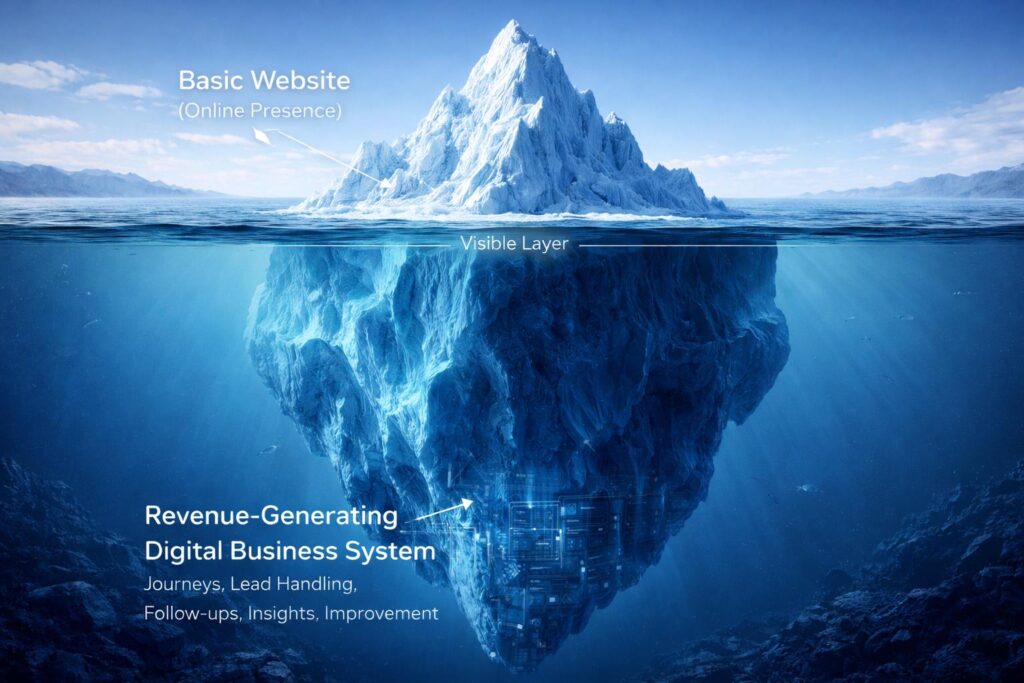
The Iceberg Moment: Why What You See Is Not What Makes It Work
Up to this point, everything discussed has been visible.
Pages.
Design.
Content.
Menus.
Buttons.
This is the part most people judge when they look at a website.
But successful websites work the same way an iceberg does.
What you see above the surface is only a small part of what actually keeps it afloat.
The visible part of a website is the tip.
The real weight sits underneath.
Below the surface live things most visitors never notice.
How enquiries are captured, not just where the form sits.
How quickly someone receives a response after reaching out.
How follow-ups happen without relying on memory.
How context is carried from the website into the conversation.
How the business knows what is working and what is not.
None of this changes how the website looks at first glance.
But it completely changes how it behaves.
This is why copying the design of a successful website rarely produces the same results.
The design is visible.
The system underneath is not.
Two websites can look equally clean, modern, and professional.
One quietly supports consistent enquiries and clear conversations.
The other depends on chance, timing, and individual effort.
The difference is not aesthetic.
It is structural.
Successful websites appear simple on the outside because complexity has been handled underneath.
Once this is understood, the conversation shifts from “how should the website look?” to “how should the system work?”
What Actually Happens After Someone Clicks “Contact”
For many businesses, this is where things quietly fall apart.
A visitor fills out a form or clicks a contact button.
From the outside, it looks like a simple action.
What happens next makes all the difference.
On a basic website, the enquiry usually lands in an inbox.
Someone sees it when they see it.
They reply when they get time.
Details are remembered or forgotten.
Follow-ups depend on mood, workload, or memory.
Nothing is intentionally broken.
Nothing is intentionally ignored.
But the experience is inconsistent.
Sometimes the response is quick.
Sometimes it is delayed.
Sometimes it never happens.
For the person who reached out, silence feels like disinterest.
For the business, the enquiry feels vague and unstructured.
On a system-driven website, the moment after the click is planned.
The enquiry is acknowledged immediately.
Context about what the person was looking at is captured.
The right person inside the business is alerted.
The next step is clear, not assumed.
Follow-ups do not depend on remembering.
They happen because the system supports them.
This changes the quality of the conversation.
Instead of “I saw your website and wanted to ask something,” the enquiry arrives with clarity.
The business knows why the person reached out.
The visitor feels seen and responded to.
The difference is not in the form.
It is in what happens after it is submitted.
This is one of the least visible parts of a website, and one of the most important.
Why Some Websites Improve Over Time and Others Stay the Same
Many websites are launched and then left alone.
They exist.
They function.
They occasionally bring enquiries.
But nothing really changes.
When results are inconsistent, there is no clear way to understand why.
When something works, it is hard to repeat.
When something doesn’t, it is hard to fix.
This is not because the business does not care.
It is because the website was never designed to learn.
On a presence-focused website, there is very little visibility.
It is unclear:
Where enquiries are coming from
What visitors did before reaching out
Which pages helped build confidence
Which pages caused hesitation or drop-off
Without this visibility, improvement becomes guesswork.
Changes are made based on opinion rather than insight.
Results feel random because they are not being measured meaningfully.
A system-driven website behaves differently.
It treats every enquiry as feedback.
Patterns begin to emerge.
Certain journeys lead to clearer conversations.
Certain content reduces confusion.
Certain entry points perform better than others.
Because this information is visible, the system can evolve.
Journeys can be refined.
Messages can be clarified.
Friction can be removed.
As the business grows, the website does not become harder to manage.
It becomes more valuable.
This is what scalability actually looks like in practice.
Not just handling more visitors, but handling them with the same clarity, consistency, and reliability over time.
Some websites stay the same because they were built to exist.
Others improve because they were built to learn.
The Full Comparison: A Presence vs a System
By this point, the difference is no longer about design, layout, or how modern a website looks.
It is about whether the website exists as a visible presence
or
operates as a connected system that supports the business day after day.
The comparison below is not a feature checklist.
It is a clarity check.
It shows how the same idea “a website” behaves very differently depending on how it is designed and what it is expected to do.
| Aspect | Basic Website | Revenue-Generating Website and Digital Infrastructure Ecosystem |
|---|---|---|
| Core purpose | Online presence | Business growth and enquiry generation |
| Primary role | Displays information | Acts as a digital sales and enquiry system |
| How it is planned | Page based | Educational, trust-building, and intent driven |
| Business understanding | Minimal | Deep understanding of business, audience, and goals |
| Website structure | Fixed pages | Structured for discovery, clarity, and action |
| Visitor experience | Passive browsing | Guided experience with clear next steps |
| Content approach | Descriptive | Intent-based and strategically placed |
| Discovery and visibility | Exists online | Designed to be found where people search and look |
| Local presence alignment | Often disconnected | Website and local business presence work together |
| Calls to action | Generic or limited | Intent based and strategically placed |
| Landing pages | Usually not included | Built for specific needs and enquiries |
| Lead capture | Basic contact form | Structured forms capturing context and intent |
| Enquiry quality | Mixed and unpredictable | Higher relevance and clarity |
| Response handling | Manual and inconsistent | Immediate acknowledgements and internal alerts |
| Follow up system | Depends on memory | Automated and reliable |
| Lead management | Inbox based | Centralised and trackable |
| Visibility into enquiries | Limited | Clear view of sources, behaviour, and outcomes |
| Sales support | Not connected | Integrated with sales and enquiry handling |
| Performance focus | Design and appearance | Speed, reliability, trust, and usability |
| Security and stability | Basic | Hardened and monitored |
| Scalability | Difficult to extend | Built to grow with the business |
| Long term improvement | Rarely evolves | Improves continuously with insights |
| Outcome | Website exists | Digital system supports consistent growth |
Seen this way, the difference is no longer subtle.
One approach focuses on being present.
The other focuses on being effective.
Both are valid.
They are simply designed for very different outcomes.
When a Basic Website Is the Right Choice
A basic website is not a lesser option.
It is a specific one.
There are many situations where a simple online presence is exactly what makes sense.
A basic website is appropriate when:
You only need people to find basic information about your business
You are validating an idea or offering
You are not actively relying on online enquiries
Your website is primarily informational
In these cases, adding layers of systems and structure would add complexity without meaningful benefit.
Clarity is more important than capability.
A basic website does its job well when it is allowed to do only what it was designed for.
Understanding this prevents unnecessary frustration and keeps expectations aligned with reality.
When a Revenue-Generating Digital Ecosystem Becomes Necessary
A revenue-generating website and digital infrastructure ecosystem becomes necessary when the website is no longer just a reference point, but a meaningful part of how the business operates.
This shift usually happens quietly.
Enquiries start to matter more.
Consistency starts to matter more.
Clarity in conversations starts to matter more.
A system-driven approach becomes important when:
You want enquiries to arrive regularly, not occasionally
You want to know how people found you and why they reached out
You want your website to support sales conversations, not complicate them
You want follow-ups to be reliable instead of dependent on memory
You want the business to grow without creating chaos behind the scenes
At this stage, a website is no longer just “online presence”.
It becomes part of the operating system of the business.
Decisions are guided.
Responses are timely.
Conversations start with context instead of confusion.
The website stops being something you maintain and starts being something that actively supports how the business runs day to day.
This is not about ambition or scale.
It is about alignment.
When online enquiries matter, systems matter.
How to Decide Which You Need: Quick Self-Assessment
Use the table below as a simple decision aid. Read each row and see which column describes your current reality more accurately.
| If this sounds like you… | A Basic Website Is Likely Enough | You Likely Need a Revenue-Generating Digital Ecosystem |
|---|---|---|
| Primary expectation from the website | People just need to see basic information | The website should actively support enquiries and conversations |
| How visitors usually find you | Most already know you or were referred | Many discover you for the first time online |
| Role of the website in sales | Rarely involved in sales discussions | Often the starting point of sales conversations |
| Impact of a missed or delayed enquiry | Little to no impact | Noticeable impact on business |
| How follow-ups happen | Depends on individual memory and time | Should happen reliably, even during busy periods |
| Need for visibility into enquiries | Not important to know sources or paths | Important to know where enquiries come from and why |
| How often the website changes | Rarely updated once live | Expected to improve as insights emerge |
| Comfort with unpredictability | Enquiries can be occasional or uneven | Enquiries should be consistent and clear |
| Effect of growth on operations | Growth won’t change how enquiries are handled | Growth would create confusion without systems |
How to read the result
If the left column reflects your situation more often, a basic website is doing its job.
If the right column resonates more, the decision is no longer about having a “better website”.
It is about whether your business needs a website that operates as a system rather than just a presence.
Frequently Asked Questions
Isn’t this just a fancy way of saying “a better website”?
No. A better-looking website is still just a website. The difference described here is not about polish or design quality. It is about whether the website exists as a static presence or operates as a system that supports enquiries, follow-ups, and learning over time. Two websites can look equally good and behave very differently.
Can’t I just add these things later if I need them?
Some elements can be added later, but many foundational decisions cannot be easily retrofitted. Structure, journeys, and how enquiries are handled are easiest to design at the start. Adding systems later often means rebuilding parts of the website rather than extending it.
I already get enquiries. Why do I need all this?
Getting enquiries is not the same as getting consistent, high-quality enquiries. Many businesses receive enquiries but struggle with clarity, follow-ups, or knowing what actually works. A system is not about increasing volume at all costs. It is about improving reliability, relevance, and visibility.
Is this only for large or fast-growing businesses?
No. This is not about size. It is about dependency. If your business depends on online enquiries, even at a modest scale, clarity and consistency matter. Smaller businesses often benefit more because missed enquiries and poor follow-up hurt them disproportionately.
Does this mean a basic website is a bad investment?
Not at all. A basic website is a correct solution for many situations. It becomes a problem only when it is expected to behave like a growth system. When the role is clear, a basic website does its job well.
Will this automatically guarantee more revenue?
No system can guarantee outcomes. What it does provide is structure. It reduces randomness, improves response quality, and creates visibility into what is working and what is not. Revenue improves as a result of better decisions, not magic.
Is this mostly about automation and tools?
Tools support the system, but they are not the system. The real difference lies in planning, intent, sequencing, and follow-through. Tools without structure simply move chaos faster.
Why can’t I just copy what a successful competitor is doing?
You can copy what is visible. You cannot easily copy what is underneath. Competitors’ success usually comes from how enquiries are handled, how journeys are structured, and how decisions are guided. Those things are not obvious from the outside.
How do I know which approach I actually need right now?
Ask one simple question:
If someone visits your website today and shows interest, do you have a clear, reliable way to guide, respond, follow up, and learn from that interaction?
If the answer is no, you are not deciding between website styles. You are deciding between presence and system.
The Real Decision
At the end of the day, this is not a design decision.
It is not a technology decision.
And it is not a question of having a “better looking” website.
It is a decision about role.
Are you building something that simply exists online
or
Are you building something that actively supports how your business attracts, handles, and converts interest?
A basic website answers a simple question:
“Can people find information about my business online?”
A revenue-generating digital ecosystem answers a different one:
“Can my online presence consistently help the right people find me, trust me, and take the next step?”
Neither choice is inherently right or wrong.
The problem only arises when the two are confused.
Once the distinction is clear, expectations become realistic, decisions become easier, and outcomes improve.
At that point, a website stops being a source of frustration
and starts being exactly what it was designed to be.
