

Search engine optimization (SEO) is one of the most data-driven aspects of digital marketing — yet, it’s also one of the most misunderstood. Businesses often chase traffic and rankings without realizing that SEO success evolves through distinct stages, and each stage has its own key performance indicators (KPIs) that truly matter.
Tracking the wrong metric too early can lead to confusion, wasted effort, or premature conclusions that “SEO isn’t working.”
This post breaks down which SEO KPIs matter most, when you should focus on them, and how they differ between business (lead-generation) websites and e-commerce websites.
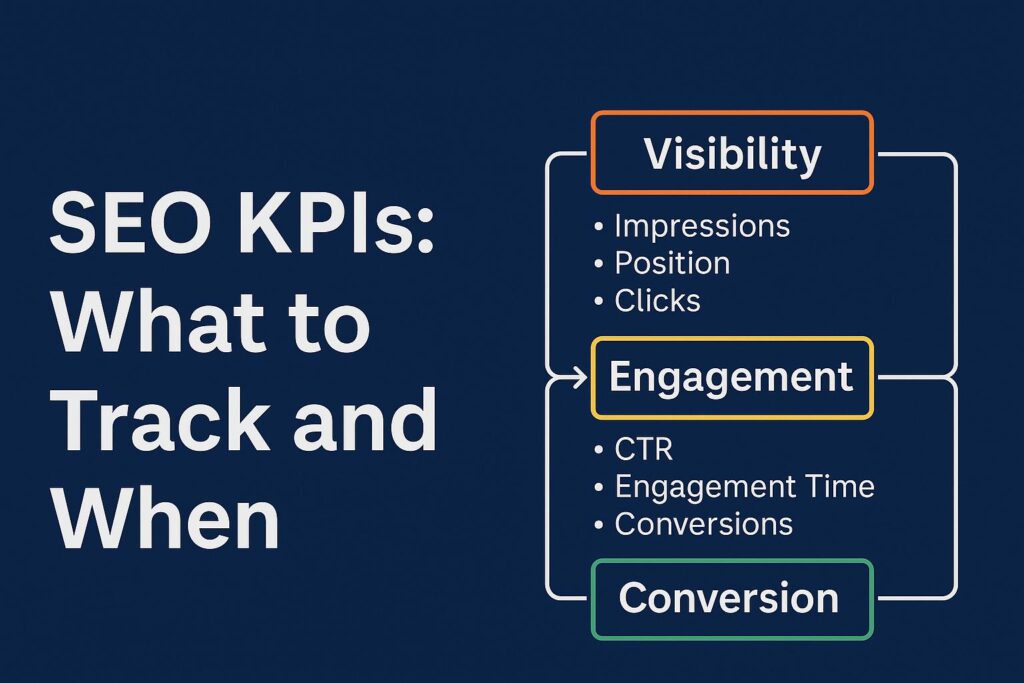
Understanding SEO KPIs: The Three Stages of Growth
Every SEO journey can be divided into three logical stages:
- Visibility Stage (0–3 months) — Getting discovered and indexed
- Engagement Stage (3–6 months) — Building clicks and interaction
- Conversion Stage (6–12+ months) — Turning visitors into leads or sales
Each stage requires attention to a specific set of KPIs that reflect progress and performance. Let’s break these down separately for Business Websites and E-commerce Websites.
SEO KPIs for Business Websites
Business websites — whether B2B companies, service providers, or local brands — have one core objective: generate high-quality leads that eventually turn into paying clients.
However, leads and sales are lagging indicators. Before you can measure them, you must build visibility and engagement.
Here’s how your SEO KPI priorities should evolve.
Stage 1: Foundation and Visibility (0–3 months)
In the initial months, your website is just starting to gain traction in Google’s index. The goal here is to ensure proper crawling, indexing, and early keyword visibility.
Key KPIs to Focus On
| KPI | What It Measures | Why It Matters |
|---|---|---|
| Impressions | How often your site appears in search results | Indicates that Google is discovering and showing your pages |
| Average Position | Your keyword ranking in search results | Helps measure early SEO progress and keyword mapping accuracy |
| Crawl Errors & Index Coverage | Technical site health | Ensures your pages are discoverable and error-free |
| Core Web Vitals / Page Speed | User experience and technical optimization | Affects both rankings and user satisfaction |
At this stage, don’t worry about clicks or conversions yet. Focus on getting indexed, fixing technical issues, and establishing keyword presence.
Tools to Use
- Google Search Console (GSC) for impressions and position
- Screaming Frog / Site Audit tools for crawl status
- PageSpeed Insights and Lighthouse for performance metrics
Stage 2: Engagement and Traffic Growth (3–6 months)
Once your site starts appearing in search results, the next goal is to attract users and keep them engaged.
At this stage, you shift from visibility metrics to interaction metrics.
Key KPIs to Focus On
| KPI | What It Measures | Why It Matters |
|---|---|---|
| Clicks (Organic) | Number of visits from search | Indicates whether your snippets are compelling |
| CTR (Click-Through Rate) | Percentage of impressions that result in clicks | Helps refine meta titles and descriptions |
| Engagement Time / Avg. Time on Page | How long users spend on content | Shows content relevance and quality |
| Bounce Rate / Engagement Rate | Whether visitors stay or leave quickly | Indicates content-to-intent alignment |
During this phase, improving CTR and engagement time directly impacts your rankings and prepares your site for conversions later.
Optimization Tips
- A/B test meta titles and descriptions for better CTR
- Improve internal linking to guide user flow
- Use engaging visuals, headings, and CTAs to reduce bounce rate
Stage 3: Conversion and ROI (6–12+ months)
By this time, your SEO efforts are generating meaningful traffic. Now it’s time to convert those visitors into measurable business outcomes.
Key KPIs to Focus On
| KPI | What It Measures | Why It Matters |
|---|---|---|
| Leads (Form Fills / Calls) | Number of inquiries from organic traffic | The ultimate KPI for service businesses |
| Lead Quality (MQLs / SQLs) | Relevance of generated leads | Helps assess if your SEO is targeting the right audience |
| Sales / Revenue from Organic | Actual business outcomes | Validates the ROI of SEO |
| Cost per Lead (CPL) | Efficiency metric | Compares SEO against paid channels |
| Returning Visitors / Branded Traffic | Brand recall and loyalty | Indicates trust built via SEO |
At this point, SEO becomes a measurable part of your sales pipeline, not just a marketing effort.
Tools to Use
- Google Analytics (GA4) for conversions
- CRM integration for lead tracking
- Call tracking tools to measure phone conversions
Complete KPI List for Business Websites
- Impressions
- Average Position
- Clicks (Organic)
- CTR (Click-Through Rate)
- Engagement Time / Avg. Time on Page
- Bounce Rate / Engagement Rate
- Leads (Form Submissions / Calls)
- Conversion Rate
- Lead Quality (MQLs, SQLs)
- Sales / Closed Deals
- Cost per Lead (CPL)
- Returning Visitors
- Branded Traffic Share
- Domain Authority / Backlinks
- Core Web Vitals
SEO KPIs for E-commerce Websites
E-commerce SEO has the same foundation as business websites — visibility, engagement, and conversion — but the metrics focus on product performance, checkout behavior, and revenue.
Here’s how the KPIs evolve through each stage.
Stage 1: Visibility and Indexation (0–3 months)
Your first goal is to make sure every important product and category is visible in search results.
Key KPIs
| KPI | What It Measures | Why It Matters |
|---|---|---|
| Impressions | How often product pages appear in search | Visibility baseline |
| Average Position | Ranking performance | Helps refine keyword targeting |
| Indexed Product Pages | Crawl and index status | Ensures your catalog is fully discoverable |
| Site Speed / Core Web Vitals | Load times and UX | Affects ranking and conversion |
| Mobile Usability | Mobile shopping experience | Critical for conversions on mobile |
This stage is all about technical SEO and discoverability — clean URLs, structured data, and optimized product descriptions.
Stage 2: Engagement and Traffic (3–6 months)
Once your products are showing up, you want people to click, browse, and interact.
Key KPIs
| KPI | What It Measures | Why It Matters |
|---|---|---|
| Organic Clicks | Actual visitors from search | Indicates SEO growth |
| CTR (Click-Through Rate) | SERP performance | Helps refine product titles and meta tags |
| Sessions / Users | Overall organic traffic | Tracks traffic volume |
| Product Page Engagement Time | Time spent viewing products | Reveals product relevance and interest |
| Pages per Session | Browsing depth | Indicates effective navigation and cross-selling |
| Bounce Rate | Early exits | Helps identify weak product or landing pages |
During this phase, the goal is to improve engagement and guide users toward purchase intent.
Stage 3: Conversions and Revenue (6–12+ months)
Now your e-commerce store is attracting steady traffic. It’s time to measure what really matters — sales and revenue.
Key KPIs
| KPI | What It Measures | Why It Matters |
|---|---|---|
| Add to Cart Rate | % of visitors adding items | Measures buyer intent |
| Checkout Abandonment Rate | % leaving checkout | Identifies UX or trust issues |
| Conversion Rate (CVR) | % of visitors completing a purchase | Core sales KPI |
| Revenue from Organic | Total sales from SEO | Determines SEO ROI |
| Average Order Value (AOV) | Average basket size | Helps measure upselling success |
| Customer Lifetime Value (CLV) | Long-term customer worth | Indicates SEO’s branding effect |
| Organic Share of Revenue | SEO’s contribution to total revenue | Strategic ROI measure |
| Returning Customers / Repeat Purchases | Customer loyalty | Measures retention and brand strength |
At this level, SEO drives not just traffic but sustainable business growth.
Complete KPI List for E-commerce Websites
- Impressions
- Average Position
- Organic Clicks
- CTR
- Product Page Engagement Time
- Bounce Rate
- Add to Cart Rate
- Checkout Abandonment Rate
- Conversion Rate
- Revenue from Organic
- Average Order Value (AOV)
- Customer Lifetime Value (CLV)
- Returning Customers / Repeat Purchases
- Organic Share of Revenue
- Backlink Growth / Domain Authority
- Core Web Vitals
The KPI Evolution Timeline
| Stage | Business Website Focus | E-commerce Website Focus |
|---|---|---|
| 0–3 months (Visibility) | Impressions, Rankings, Indexation | Impressions, Indexed Products, Speed |
| 3–6 months (Engagement) | Clicks, CTR, Engagement, Bounce Rate | Clicks, CTR, Product Page Engagement |
| 6–12+ months (Conversion) | Leads, Conversions, ROI | Add to Cart, Conversion Rate, Revenue |
SEO is a long-term performance channel, not a sprint. You can’t expect conversions before building visibility, and you can’t measure ROI before engagement begins.
Pro Tip: Map SEO KPIs to Business Goals
| Business Objective | Primary SEO KPIs | Secondary Supporting KPIs |
|---|---|---|
| Brand Awareness | Impressions, CTR | Backlinks, Position Growth |
| Engagement / Education | Avg. Time on Page, Pages per Session | Returning Visitors |
| Lead Generation | Conversions, Lead Quality | CTR, Bounce Rate |
| Sales / Revenue | Organic Revenue, Conversion Rate | AOV, CLV |
| Customer Retention | Returning Visitors / Repeat Purchases | Engagement Rate |
By linking each KPI directly to a real business outcome, you make SEO accountable and measurable.
Bonus: Tools You’ll Need to Measure KPIs Accurately
- Google Search Console (GSC) — Rankings, CTR, impressions
- Google Analytics 4 (GA4) — Traffic, engagement, conversions
- Google Data Studio / Looker Studio — KPI dashboards and visualization
- Screaming Frog / Ahrefs / SEMrush — Technical and backlink insights
- Hotjar / Microsoft Clarity — Heatmaps and user engagement patterns
Final Thoughts
SEO success is not defined by a single number. It’s a journey through three stages — Visibility, Engagement, and Conversion — each demanding focus on different KPIs.
- For business websites, the end goal is qualified leads and client acquisition.
- For e-commerce websites, it’s organic sales, customer retention, and long-term profitability.
By tracking the right KPIs at the right stage, you can see exactly where your SEO is working, where it’s stuck, and how to move from traffic to tangible business results.
