

Ask five Shopify agencies what a store costs in India and you will get five different numbers, usually because each one is quoting a different part of the bill. The Shopify subscription is the smallest line item in most budgets, yet it is the only figure most guides mention. The real cost of a Shopify website in India lives in development, design, apps, and the transaction fees Shopify charges every Indian merchant on every single order.
This breaks down what a Shopify store actually costs in India in 2026, plan by plan and expense by expense, so you can budget for the real number instead of the headline one.
The Shopify Subscription Is Not the Cost, It’s the Entry Fee
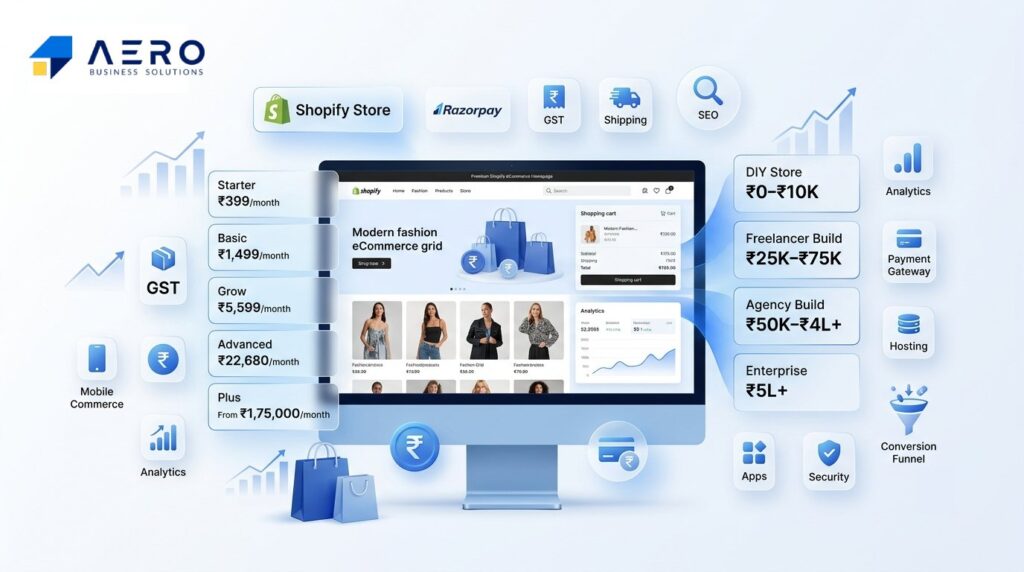
Shopify sells five plans in India, all billed in INR:
- Starter: ₹399/month. Not a website. It gives you shoppable links for social media and a checkout page, nothing more.
- Basic: ₹1,499/month (annual billing). A full storefront, unlimited products, and a 2% transaction fee. Right for stores doing under ₹3-4 lakh/month. Hosting is included in every plan, and Shopify notes that its checkout converts noticeably better on average than competing platforms, which matters when weighing plan cost against expected conversion lift.
- Grow: ₹5,599/month. Transaction fee drops to 1%. Pays for itself once monthly revenue crosses roughly ₹4 lakh.
- Advanced: ₹22,680/month. Transaction fee falls to 0.5%. Only worth it above roughly ₹40-42 lakh/month in sales.
- Plus: From ₹1,75,000/month on a multi-year commitment. Built for enterprise catalogs, multi-store setups, or B2B complexity.
Add 18% GST on top of every plan. A ₹1,499 Basic plan is closer to ₹1,769/month once tax is included. If your business is GST-registered, this is claimable as Input Tax Credit, which softens the blow but doesn’t remove it from your monthly cash flow.
The plan you pick should be driven by one number: your monthly revenue, not your feature wishlist. Basic covers most first stores. Upgrading before you have the sales volume to justify it is money spent on features you won’t use yet.
Transaction Fees: The Cost Every Indian Merchant Forgets to Budget For
This is the part most first-time Shopify buyers in India miss entirely. Shopify Payments, the feature that waives transaction fees in the US and UK, is not available in India. Shopify’s own pricing page confirms that Shopify Payments availability varies by country, with pricing and payment options differing depending on where a business is based. Every Indian merchant has to route payments through a third-party gateway like Razorpay, PayU, or Cashfree, and Shopify charges its own fee on top of whatever that gateway charges.
At the Basic plan, that fee is 2% of every transaction. On a store doing ₹5 lakh a month, that’s ₹10,000 gone to Shopify before the payment gateway takes its own 1.8-2.5%. Combined, transaction costs alone can eat 4-4.5% of revenue, on top of the subscription.
This is why the plan comparison isn’t really about features. It’s arithmetic: at what revenue level does the transaction fee saving from the next plan up exceed the extra subscription cost? For most Indian D2C brands, that crossover happens around ₹4 lakh/month for the jump to Grow, and around ₹40-42 lakh/month for the jump to Advanced. A lot of stores stay on Basic well past the point where Grow would have been cheaper overall, simply because nobody ran the math.
Development Cost: Where the Real Money Goes
This is the number people are actually asking about when they search “Shopify website development cost in India,” and it varies more than any other line item because it depends entirely on who builds the store and how custom it is.
DIY with a free theme: Effectively ₹0 in development cost, but you’re doing the setup, product uploads, and configuration yourself. Realistic for a very small catalog with no custom design needs. Time cost is high; cash cost is low.
Freelance Shopify developer in India: Hourly rates typically run ₹1,000-1,500. A straightforward store built on a premium theme with standard customization, product catalog setup, payment gateway integration, and basic SEO configuration usually lands somewhere between ₹25,000 and ₹75,000 depending on catalog size and how much custom theme work is involved. Freelancers are a reasonable fit if your requirements are simple and you’re comfortable managing the project yourself.
Shopify agency in India: A fixed-price, professionally built store, complete with Razorpay/GST/Shiprocket integration, a conversion-optimized layout, and post-launch support, typically runs from ₹50,000 for a straightforward D2C store up to several lakh rupees for a highly custom build with bespoke app integrations, multi-currency support, or headless architecture. Agencies charge more than freelancers because the price includes project management, QA, and accountability if something breaks after launch, not just the hours of coding.
The gap between a freelancer quote and an agency quote is rarely about the code being better. It’s about what happens in week three when the payment gateway integration breaks or a client wants a scope change. A freelancer working solo has limited bandwidth to absorb that; an agency has a process for it.
Theme and Design Costs
Shopify’s free themes are functional but generic, and it shows the moment a customer compares your store to a competitor’s. A premium theme from the Shopify Theme Store is a one-time purchase, generally in the ₹15,000-25,000 range depending on the theme’s complexity and how commonly it’s used, worth avoiding if you want a store that doesn’t look like a template.
A fully custom design, meaning original layouts, brand-specific typography and color systems, and bespoke product page treatments, isn’t priced as a theme purchase at all. It’s part of the development quote, and it’s usually where the biggest gap sits between a ₹50,000 store and a ₹2-3 lakh store. If your brand differentiation matters more than speed to launch, this is the line item to spend on.
Apps: The Recurring Cost Nobody Quotes Upfront
A functional Indian Shopify store typically runs 6-12 apps: reviews, abandoned cart recovery, upsell/cross-sell, WhatsApp integration, loyalty, and analytics being the common ones. Many have usable free tiers, but a well-configured store usually needs ₹2,000-6,000/month in paid app subscriptions once it scales past the testing phase. Budget for this as a recurring cost, not a one-time development expense, because it doesn’t stop after launch.
Domain, Hosting, and the Costs That Are Actually Included
Hosting is bundled into every Shopify plan, so there’s no separate hosting bill to budget for, unlike a WordPress store. A custom .com domain through a registrar like GoDaddy or Namecheap runs ₹700-1,500/year, a rounding error compared to everything else on this list, but easy to forget when adding up a first-year budget.
What a Realistic Total Looks Like
For a small-to-mid D2C brand launching in India in 2026, here’s a defensible range rather than a single misleading number:
- Lean launch (Basic plan, freelance developer, premium theme, minimal apps): ₹80,000-1,50,000 for setup, then roughly ₹5,000-8,000/month in ongoing platform, app, and transaction costs at modest sales volume.
- Agency-built D2C store (Basic or Grow plan, custom design, full India payment/shipping stack, essential apps): ₹1,50,000-4,00,000 for setup, then ₹15,000-30,000/month in total platform costs once the store is doing ₹5 lakh/month+ in revenue.
- Enterprise or highly custom build (Advanced or Plus, headless or multi-store architecture): Development alone can run into several lakh rupees, with platform costs scaling from there.
The number that should worry you isn’t the setup cost. It’s the ongoing percentage of revenue going to transaction fees and apps, because that number compounds every month your store is live, while the development cost is paid once.
Why This Math Matters More Every Year
None of this cost planning happens in a vacuum. India’s e-commerce market is on a steep growth curve, projected to expand from roughly US$125 billion in 2024 to around US$345 billion by 2030, according to the India Brand Equity Foundation (IBEF), a trade promotion body under India’s Ministry of Commerce and Industry. A store that gets its cost structure right today is better positioned to absorb that growth without its margins being eaten alive by fees nobody budgeted for at launch.
Getting the Plan Right Before You Spend on Development
The most expensive mistake in Shopify development isn’t overpaying a developer, it’s building on the wrong plan for your revenue stage and then re-platforming or renegotiating six months in. Before committing to a development budget, it’s worth running the actual math on where your transaction fee savings cross over into justifying a higher plan, because that number should shape what you brief your developer or agency to build in the first place.
If you’re weighing DIY against a freelancer against an agency for your Shopify build, the right choice usually comes down to how much your time is worth and how custom your design needs actually are, not which option has the lowest sticker price.
Sources: Shopify official pricing page; Shopify Help Center, Pricing Plans; India Brand Equity Foundation (IBEF), E-commerce Industry in India. Plan prices, fees, and figures reflect published rates as of mid-2026 and are subject to change; confirm current pricing directly with Shopify before committing to a plan.
