

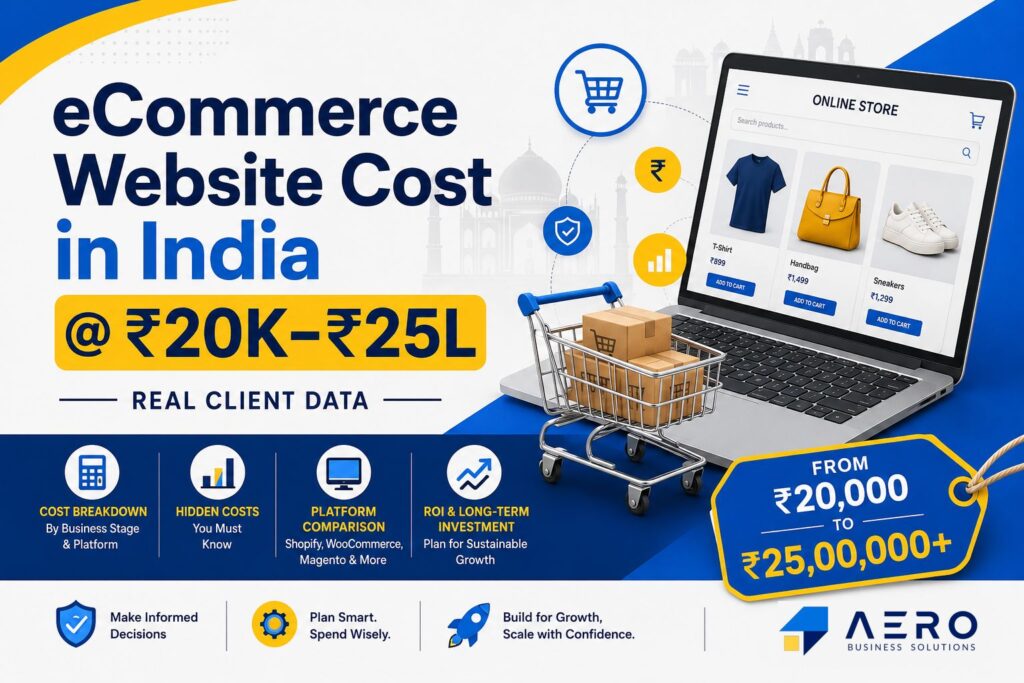
An eCommerce website in India costs anywhere between ₹20,000 and ₹25,00,000, depending on your business type, product catalog size, platform, and how much custom design and development you need.
That’s a wide range, and most guides stop there. This one doesn’t. Below, you’ll find pricing broken down by business stage, a dedicated look at design cost (which is usually priced and discussed separately from development), platform-by-platform comparisons, and the hidden costs that show up after launch, all specific to the Indian market in 2026.
If you’re weighing eCommerce against a broader business website first, our website development cost in India guide breaks down pricing for corporate sites, portfolios, and service businesses.
Demand for online buying in India isn’t slowing down either. According to the India Brand Equity Foundation, India’s e-commerce market is projected to grow at a 27% CAGR, which is exactly why getting the infrastructure decision right at the outset matters more than chasing the lowest quote.
Cost Snapshot: eCommerce Website Price in India
| Website Type | Typical Cost Range |
|---|---|
| Single Product Website | ₹20,000 – ₹40,000 |
| Small Store (10–100 products) | ₹40,000 – ₹80,000 |
| Medium Store (100–500 products) | ₹80,000 – ₹3,50,000 |
| Large Store (500+ products) | ₹1,50,000 – ₹20,00,000+ |
| Custom Enterprise Platform | ₹5,00,000 – ₹25,00,000+ |
Two stores with the same product count can still land at very different prices. The real cost drivers are:
- Platform choice (Shopify, WooCommerce, Magento, or custom)
- How much custom design and UX work is involved
- Third-party integrations (ERP, CRM, shipping, payments)
- Hosting and performance requirements
- How much long-term scalability you’re building in from day one
Table of Contents
eCommerce Website Cost Calculator India
Estimate your eCommerce website development cost, annual running expenses, platform recommendation, and ROI in under 60 seconds.
Your Estimated Results
Development Cost
Recommended Platform
Annual Running Cost
Growth Readiness Score
ROI & Break-Even Analysis
Our Recommendation
Need a Detailed Project Estimate?
Get a personalized eCommerce development roadmap, exact quotation, platform recommendation, and growth strategy from our experts.
Get Free ConsultationWhy eCommerce Website Pricing Varies So Much in India
A ₹20,000 gap between two site quotes is easy to explain. A ₹5,00,000 gap needs more context, and it usually comes down to five things.
Platform. A Shopify store on a premium theme with light customization is a different cost category from a fully custom-coded build. Neither is automatically the wrong choice, but they’re not comparable on price alone.
Depth of customization. Layout tweaks and branding adjustments are inexpensive. Custom checkout logic, subscription models, multi-vendor functionality, and recommendation engines are not, because each one is closer to software development than website design.
Integrations. Every payment gateway, shipping aggregator, ERP connection, or CRM sync adds development and testing time. A store with three integrations and a store with none can have identical front-end designs and very different price tags.
Performance and scale requirements. A store expecting 500 visitors a day doesn’t need the hosting, caching, and CDN setup that a brand running national paid campaigns does. Performance isn’t cosmetic. It’s directly tied to conversion rate.
How far ahead you’re planning. A low launch budget that ignores maintenance, app costs, and future scaling often costs more over three years than a slightly higher budget planned properly from the start.
When someone asks what an eCommerce website costs in India, the honest answer is that it depends entirely on which of these five factors your business actually needs, not on a flat industry rate.
eCommerce Website Design Cost in India
Design and development are often quoted together, but they’re not the same expense, and pricing them separately helps you understand where your money is actually going.
Template-based design: ₹15,000 – ₹50,000 A pre-built, customizable theme with your branding, colors, and layout adjustments. Fast to launch, limited to what the theme framework allows.
Semi-custom design: ₹50,000 – ₹1,50,000 A theme foundation with custom homepage sections, custom product page layouts, and a UX pass built around your specific catalog and customer journey. This is where most growing D2C brands in India land.
Fully custom design: ₹1,50,000 – ₹5,00,000+ Original UI built from scratch, typically paired with custom development rather than a theme. Used by brands where the storefront experience itself is part of the product positioning.
A cheap design isn’t automatically a bad decision, and an expensive one isn’t automatically a good one. The design budget should match how much of your customer’s buying decision happens on-page. A commodity product with price-driven buyers doesn’t need the same design investment as a premium brand selling on look and feel.
Design cost estimates above assume your brand identity already exists. If you’re starting from scratch, factor in logo design as a separate line item before the storefront design work begins, since a store built around a placeholder logo usually needs revisiting later.
Cost by Business Type
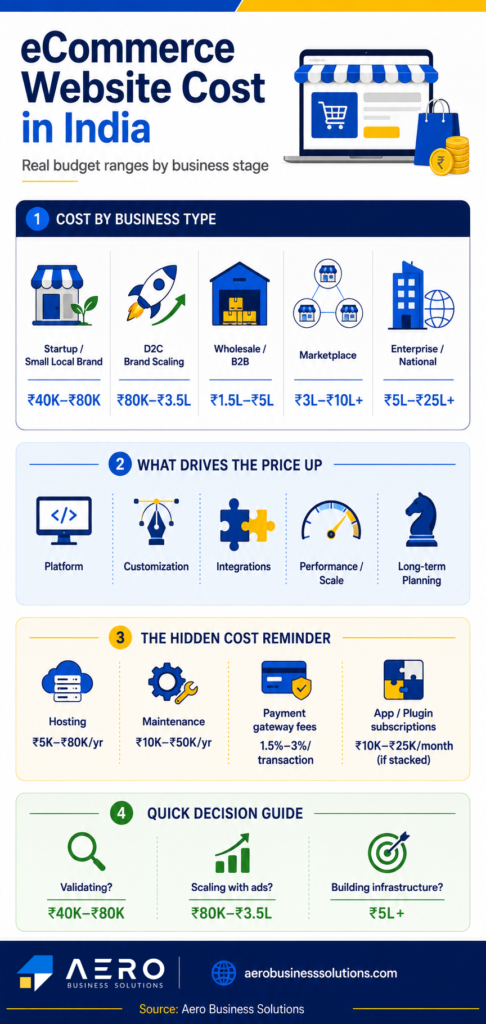
Startup or small local brand — ₹40,000 to ₹80,000 Clean design, standard checkout, payment gateway, basic shipping integration, mobile responsiveness, essential SEO. The goal at this stage is validating demand, not building infrastructure you don’t need yet.
D2C brand planning to scale — ₹80,000 to ₹3,50,000 Faster hosting, conversion-focused UX, product filtering, upsell/cross-sell logic, email automation, proper analytics. If you’re running paid ads, your website is your primary conversion asset, and underinvesting here directly raises your customer acquisition cost.
Wholesale or B2B business — ₹1,50,000 to ₹5,00,000 Bulk pricing rules, tiered customer pricing, quote request systems, GST-compliant invoicing, ERP integration, multi-user accounts. B2B logic adds real development complexity that a standard storefront doesn’t need.
Marketplace model — ₹3,00,000 to ₹10,00,000+ Vendor dashboards, commission logic, payout automation, multi-vendor inventory, dispute management. This is a platform, not a store, and should be budgeted and scoped as one.
Enterprise or national brand — ₹5,00,000 to ₹25,00,000+ Custom UI, high-performance cloud architecture, multi-language and multi-currency support, headless commerce, dedicated development support. At this level, the website is core infrastructure.
The most common budgeting mistake in India right now isn’t overspending or underspending in isolation. It’s copying a budget that belongs to a different business stage than the one you’re actually at.
Shopify vs WooCommerce vs Magento vs Custom: What They Actually Cost in India
Shopify Initial setup: ₹35,000 – ₹2,75,000. Monthly platform fee: ₹2,000 – ₹7,000. App subscriptions: ₹2,000 – ₹15,000/month. Fastest path to launch, managed hosting, strong app ecosystem. Recurring subscription and app costs compound over three years and are worth budgeting for upfront, not discovering later.
WooCommerce Initial setup: ₹30,000 – ₹2,50,000. Hosting: ₹5,000 – ₹50,000/year. Plugins: ₹5,000 – ₹50,000/year. More customization freedom and no mandatory platform fee, but hosting performance and plugin management become your responsibility. Strong option if SEO flexibility matters to you specifically.
Magento Initial setup: ₹1,50,000 – ₹20,00,000+. Requires high-performance hosting and has meaningfully higher maintenance overhead than the other options. Justified for large B2B operations, high traffic, and multi-warehouse logistics. Overkill for most small and mid-sized Indian businesses.
Fully custom development Initial setup: ₹3,00,000 – ₹25,00,000+, plus an ongoing development relationship. Makes sense for marketplaces, unique business models, or businesses that need complete backend control. Not a starting point for most first-time online sellers.
The launch price is only part of the comparison. Factor in hosting, app costs, and plugin renewals over three years, and a cheaper platform on day one can end up costing more than a properly scoped alternative.
Hidden Costs Most Businesses Don’t Budget For
App and plugin subscriptions. Individually ₹1,000–₹3,000/month each, but stacked tools for reviews, email, filters, and analytics can add ₹10,000–₹25,000/month without anyone tracking the total.
Hosting upgrades. A basic plan works until a campaign or festival spike hits. Moving to VPS or cloud hosting to handle traffic is a real, recurring cost increase, and it’s directly tied to whether your checkout stays up during your highest-revenue days.
Payment gateway fees. Typically 1.5%–3% per transaction on card and wallet payments. UPI transactions carry no merchant discount rate on most gateways, which is one reason UPI now accounts for the large majority of India’s digital payment volume, according to NPCI data. Still, at ₹10,00,000 monthly revenue on a mixed payment mix, gateway fees can run ₹20,000+ a month, an ongoing operational cost that has nothing to do with development.
Maintenance and security. ₹10,000–₹50,000 a year for updates, patches, and monitoring on small to mid stores. Skipping this is how sites end up compromised or down during peak sales periods.
Performance optimization. ₹15,000–₹1,00,000 as your catalog and traffic grow, covering database cleanup, image compression, caching, and CDN setup.
Redesign and rebuild costs. The most expensive hidden cost. Launching fast with no scalability planning often means a full rebuild within two to three years, which usually costs more than building it right the first time.
Free Guide & Checklist (PDF)
Get the Complete eCommerce Website Budget Guide
Everything in this article, plus the checklists and worksheets you’ll actually use before you sign with an agency.
What’s inside:
- Cost by business type, at a glance
- The hidden cost checklist most quotes leave out
- Shopify vs WooCommerce vs Magento vs Custom, compared
- The exact questions to ask before hiring a developer
- A break-even worksheet to calculate your own ROI timeline
Download the Free Guide
No spam. Just the guide, straight to your inbox.
How Long It Takes to Recover the Investment (ROI)
Founders usually evaluate a website by its build cost. It’s more useful to evaluate it by how fast it pays for itself, because that’s what actually determines whether the budget was right.
Take a store with ₹1,500 average order value, 10,000 monthly visitors, a 2% conversion rate, and a 40% gross margin. That’s 200 orders a month, ₹3,00,000 in monthly revenue, and ₹1,20,000 in monthly gross profit. A ₹1,20,000 website investment breaks even in roughly a month, before marketing spend is even factored in.
Even in a more conservative case, say 5,000 visitors, a 1.5% conversion rate, and ₹1,200 average order value, that’s still ₹90,000 in monthly revenue and roughly ₹31,500 in gross profit, enough to recover a ₹1,20,000 build in about four months.
The number that matters isn’t whether you spent ₹80,000 or ₹2,00,000. It’s whether the site can actually convert the traffic you’re sending it. A cheaper build that leaks conversions is the more expensive option in every case that matters.
A Real Example
One of our D2C clients came to us running a WooCommerce store built on a ₹35,000 quote from a freelancer, with no performance optimization and a template that wasn’t built for their product count. Page load times were over 6 seconds on mobile, and their cart abandonment rate reflected it. We rebuilt the storefront on a semi-custom design with proper hosting and checkout optimization for roughly ₹1,10,000. Within the first two months post-launch, their conversion rate improved enough to recover the rebuild cost from the difference alone, on top of what they’d already spent the first time. The lesson isn’t “spend more.” It’s that the cheapest quote and the cheapest total cost are frequently not the same number.
Mistakes That Cause Indian Businesses to Overpay
Most budget overruns aren’t caused by the developer or agency. They come from unclear strategy before the project starts.
Choosing a platform too advanced for the current stage. Startups sometimes pick Magento or a full custom build because it signals scale, when 50 products and moderate traffic don’t need enterprise architecture. Infrastructure should match your current stage, not your five-year ambition.
Cutting performance to save on launch cost. Cheap hosting and skipped optimization show up later as slow load times, higher cart abandonment, and lower conversion. Fixing performance after launch usually costs more than planning for it from the start.
No scalability planning. A store built without room to grow runs into database inefficiency, plugin overload, and poor categorization the moment traffic increases, and many Indian businesses end up rebuilding within two to three years as a result.
Stacking apps instead of targeted customization. Every extra plugin adds a recurring cost and another point of failure. Sometimes a small amount of custom development is cheaper long-term than five subscription tools doing overlapping jobs.
Choosing purely on the lowest quote. An unusually low price often means minimal testing, no documentation, and no real post-launch support. The savings on day one frequently show up as repair or rebuild costs within a year or two.
Comparing only the launch quote. The number that matters is total cost over three to five years, including hosting, subscriptions, maintenance, and eventual upgrades, not just what’s on the initial invoice.
How to Decide Your Budget
Don’t start with “what’s the lowest I can spend.” Start with where your business actually is:
- Validating demand? ₹40,000–₹80,000 is enough. Don’t build infrastructure for a scale you haven’t reached yet.
- Running paid ads and scaling? ₹80,000–₹3,50,000, with real weight on performance and conversion UX, not just design.
- Managing B2B logic or high SKU counts? ₹1,50,000–₹5,00,000, budgeted around integrations, not just the storefront.
- Building a marketplace or national infrastructure? ₹5,00,000+, treated as platform investment, not a website project.
A well-built store still needs traffic to justify the investment. Once launch budget is settled, most businesses underbudget for the marketing spend that actually drives sales. Our digital marketing packages are built to plug into a new or existing store without duplicating what you’ve already paid for in development.
Final Word
There’s no single correct price for an eCommerce website in India, because there’s no single type of Indian eCommerce business. The mistake isn’t choosing a higher or lower budget than someone else. It’s misalignment: underbuilding for where you’re headed, or overbuilding for where you actually are right now.
Match the investment to your current stage, plan for the hidden costs upfront rather than discovering them later, and treat the website as a revenue asset you’re building, not a one-time expense you’re minimizing.
If you’re still unsure which budget range fits your business, a free consultation is the fastest way to get a straight answer instead of guessing from averages.
Frequently Asked Questions (FAQ) About eCommerce Website Cost in India
What is the minimum cost to build an eCommerce website in India?
The minimum realistic cost is around ₹20,000 to ₹40,000, and that gets you a single-product or small-catalog store on a template with standard checkout and payment gateway integration. Anything quoted significantly below this usually means no real design work, no testing, and no post-launch support.
How much does an eCommerce website cost in India in 2026?
Most Indian businesses spend between ₹40,000 and ₹3,50,000, depending on catalog size, platform, and customization. Small stores and startups typically land at the lower end, while D2C brands running paid ads and needing conversion-focused UX spend closer to ₹1,50,000 to ₹3,50,000. Enterprise and marketplace builds go well beyond that.
What is the average cost of eCommerce website design in India?
Design cost depends on how custom the work is. Template-based design runs ₹15,000 to ₹50,000, semi-custom design with tailored layouts runs ₹50,000 to ₹1,50,000, and fully custom UI built from scratch starts around ₹1,50,000. Design is usually quoted separately from development, so ask for both line items broken out.
Is Shopify or WooCommerce cheaper in India?
WooCommerce usually has a lower recurring cost since there’s no mandatory platform fee, but you pay for hosting and manage plugins yourself. Shopify has a higher predictable monthly cost (₹2,000 to ₹7,000 plus apps) but less technical overhead. Over three years, the cheaper option depends more on how many paid apps you end up installing than on the platform itself.
How much does a custom eCommerce website cost?
Fully custom development in India typically starts at ₹3,00,000 and can go up to ₹25,00,000 or more, depending on complexity, integrations, and infrastructure. It’s rarely the right starting point for a new business. It becomes worth it when your business model genuinely can’t run on a standard platform, such as a marketplace or a business with heavy ERP dependency.
What’s included in a typical eCommerce website development quote?
A complete quote should specify: design (template or custom), development, payment gateway integration, shipping/logistics integration, hosting setup for the first year, basic SEO setup, and testing before launch. If a quote doesn’t break these out individually, ask for an itemized version before signing off, since vague quotes are the most common source of scope disputes later.
How much does eCommerce website maintenance cost per year in India?
Expect ₹10,000 to ₹50,000 a year for small to mid-sized stores, covering security patches, plugin/platform updates, and basic monitoring. Larger stores with higher traffic and more integrations can see annual maintenance exceed ₹1,00,000. Maintenance is an ongoing operational cost, not a one-time fee, and it should be budgeted separately from the build cost.
How long does it take to build an eCommerce website in India?
A simple store takes 2 to 4 weeks. A medium-complexity store with custom design and a few integrations takes 4 to 8 weeks. Large custom builds or marketplace platforms typically take 3 to 6 months, mostly due to integration testing and QA rather than design work.
Can I build an eCommerce website under ₹30,000?
Yes, but with real trade-offs: a pre-built template, minimal customization, limited or no integrations beyond a basic payment gateway, and shared hosting. This works for early validation when you just need to test if people will buy the product online, but it’s rarely built to handle growth without a rebuild.
What’s the cost difference between an eCommerce website and an eCommerce app?
A website is almost always cheaper to build and maintain than a native mobile app. A website in the ₹80,000 to ₹3,50,000 range covers most D2C needs, while a native app (iOS and Android) typically adds ₹3,00,000 to ₹10,00,000+ on top, plus ongoing costs for app store maintenance and updates. Most businesses should have a strong, mobile-optimized website before considering a dedicated app.
Is custom eCommerce development worth the extra cost?
It’s worth it when your business logic doesn’t fit standard platforms, for example multi-vendor marketplaces, complex B2B pricing tiers, or high-volume operations needing deep ERP integration. For most startups and small to mid-sized businesses, a well-configured Shopify or WooCommerce store delivers the same customer experience for a fraction of the cost.
What payment terms are standard for eCommerce website projects in India?
Most Indian agencies work on a milestone basis: an advance (commonly 40-50%) to begin, a second payment on design approval, and the balance before final handover or launch. Avoid paying the full amount upfront, and avoid agencies unwilling to show a working demo before the final payment.
What increases eCommerce website cost the most?
Customization and integrations, not the platform itself. Standard design with a standard payment gateway is inexpensive almost regardless of platform. The cost climbs when you add custom checkout logic, ERP or CRM sync, multi-vendor functionality, or advanced personalization, since each of these is closer to software development than website design.
Do I need a separate budget for branding or is it included in the website cost?
It’s usually separate. Website quotes typically assume your logo and brand identity already exist. If you’re starting from scratch, budget for logo and brand design as its own line item before storefront design begins, since building a store around a placeholder identity often means redesigning it later.
How much should I budget for marketing after the website is built?
A website drives sales only if people find it. Most D2C brands budget a monthly marketing spend roughly equal to or greater than their one-time development cost within the first few months, covering paid ads, SEO, and content. Building the store without planning for this is one of the most common reasons new eCommerce sites see low traffic despite a solid build.

Insightful breakdown of eCommerce website development costs in India for 2023! Your detailed analysis on various aspects like design, functionality, and maintenance costs provides a clear roadmap for businesses planning their online presence. Have you observed any emerging trends that might impact these costs in the near future? Looking forward to more informative blogs from you on the dynamic landscape of eCommerce development!
Thanks for sharing this valuable content and making this topic so easy for readers to understand. Your efforts are greatly appreciated.