

The SEO Industry Is Focused on the Wrong Debate
For the past few years, the SEO industry has been obsessed with one question:
“Can AI-generated content rank on Google?”
But after watching real-world websites grow through multiple Google updates using AI-assisted publishing workflows, it has become increasingly clear that this is the wrong question entirely.
The real question is:
Does the content genuinely help users?
Because that is ultimately what modern search engines are trying to measure.
Not whether a human manually typed every sentence.
Not whether AI helped create the first draft.
Not whether the article was produced using automation somewhere in the workflow.
What matters is whether the final result deserves to rank.
And our own case study demonstrates this extremely clearly.
Our AI Content Case Study
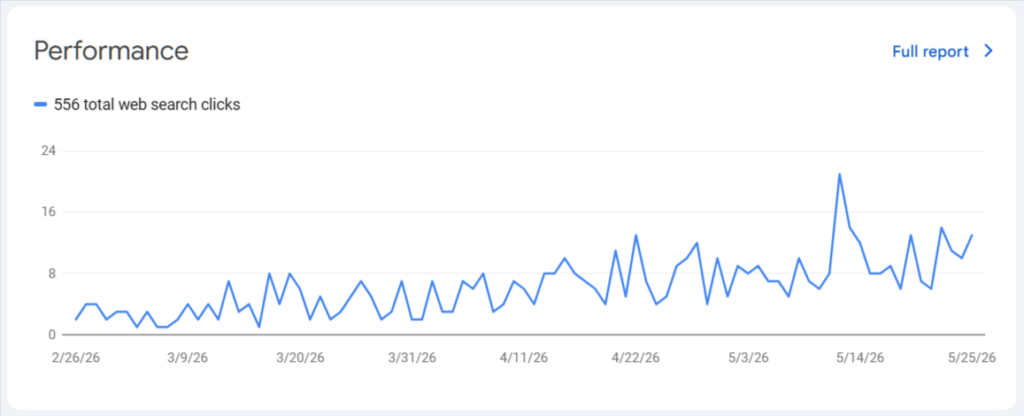
One of our projects relies heavily on AI-assisted content generation.
Not partially.
Not “AI only for outlines.”
The majority of the publishing workflow is AI-assisted, including drafting, structuring, topical expansion, and scaling supporting content.
Yet despite this, the website has shown remarkably stable and consistent growth over time.
Even more importantly, the growth continued through multiple disruptive Google algorithm updates that caused traffic volatility across large portions of the SEO industry.
Instead of collapsing after updates, the website continued compounding impressions and clicks gradually over time while consistently outranking competing websites in the same space.
That is important because it directly contradicts one of the biggest myths currently dominating SEO conversations:
The idea that Google simply “detects AI content” and suppresses it automatically.
If that were true, this type of long-term growth would not be possible.
Instead, what we observed was something much more aligned with Google’s actual public guidance.
The pages that performed best were not necessarily the pages with the most human effort behind them.
They were the pages that solved user intent best.
Google Has Never Actually Said AI Content Is Automatically Bad
A surprising amount of SEO discourse online is built around assumptions rather than Google’s real documentation.
Google has repeatedly clarified that automation and AI usage are not inherently against its guidelines. What matters is whether content is created primarily to help users or merely to manipulate rankings. Google Search Central Documentation
That distinction matters enormously.
Because many people still imagine Google’s systems operating like simplistic AI detectors scanning articles for “robotic writing.”
Modern search systems are far more sophisticated than that.
Google increasingly focuses on:
- usefulness
- relevance
- expertise
- trustworthiness
- search satisfaction
- topical depth
- user experience
This broader direction is visible throughout Google’s Search Quality Evaluator Guidelines, which consistently emphasize experience, expertise, authority, and trustworthiness in high-quality search results. Google Search Quality Evaluator Guidelines
In other words, Google cares far more about whether users are satisfied than whether AI was involved somewhere in the content creation process.
What We Learned From Scaling AI-Assisted Content
One of the most important lessons from this project was that AI itself is not the differentiator.
Value is.
AI can absolutely produce terrible content.
But humans can also produce terrible content.
The internet was already filled with low-quality, keyword-stuffed, repetitive articles long before AI became mainstream. AI did not invent shallow publishing. It simply made content production faster.
What determines success is the usefulness of the final output.
The pages that performed best on our project consistently shared several characteristics.
They were structured clearly.
They answered search intent directly.
They covered topics comprehensively.
They improved readability.
They reduced friction for users.
They solved problems efficiently.
They created a better experience than competing pages.
And importantly, the content was not blindly generated and published without oversight. AI accelerated execution, but strategy, editorial judgment, UX thinking, and topical planning still played critical roles throughout the process.
This is where many AI content experiments fail.
People assume AI itself is a ranking strategy.
It is not.
AI is simply a tool.
A weak SEO strategy combined with AI usually produces weak content faster.
But a strong SEO strategy combined with AI can create an enormous competitive advantage.
Why Most AI Content Actually Fails
A lot of AI-generated content genuinely deserves to fail in search results.
But not because Google “detected AI.”
Most AI-heavy websites fail because the content itself lacks value.
Many publishers today are mass-generating thousands of pages with:
- no expertise
- no editorial oversight
- no search intent understanding
- no originality
- no real audience insight
- no useful differentiation
The result is predictable.
Users land on the page and immediately feel the emptiness of the content.
The article technically contains words related to the topic, but it does not actually solve the problem effectively.
People bounce quickly.
Engagement drops.
Trust disappears.
Over time, rankings weaken.
This is often misinterpreted as “Google penalized AI content,” when in reality users simply rejected low-value content and Google’s systems increasingly reflected those satisfaction signals.
That distinction is critical.
Because it means the future of SEO is not about avoiding AI.
It is about avoiding useless content.
The Websites Winning With AI Usually Understand Search Better
The websites succeeding with AI are rarely the ones blindly publishing the highest number of articles.
The winners are usually the websites that understand search intent deeply and use AI to execute better systems faster.
AI enables businesses to scale:
- topical authority
- supporting content
- semantic relevance
- internal linking
- content refreshing
- research workflows
- content expansion
much faster than traditional publishing models.
This matters because modern SEO increasingly rewards topical ecosystems instead of isolated keyword pages.
A website demonstrating deep subject coverage across interconnected topics often performs better than websites relying on disconnected standalone articles.
AI dramatically reduces the friction involved in building those ecosystems.
But only when combined with strong strategy.
AI Is Becoming Infrastructure Across Industries
The broader technology industry is already moving beyond the question of whether AI should be used.
The focus is increasingly on how effectively businesses integrate AI into workflows.
Major companies like Microsoft AI, HubSpot AI Platform, and Shopify Magic are aggressively embedding AI into productivity, marketing, commerce, and operational systems because AI is rapidly becoming a foundational productivity layer rather than a niche experimental tool.
The same transition is happening in SEO and content publishing.
The future is unlikely to belong exclusively to “purely human-written” workflows or “fully automated” workflows.
Instead, the businesses that dominate search will likely be the ones combining:
- human expertise
- AI efficiency
- strong editorial systems
- audience understanding
- UX optimization
- scalable topical authority
better than competitors.
The Real Ranking Factor Is Usefulness
At its core, modern SEO appears to be moving toward something surprisingly simple.
Search engines increasingly want to rank content that genuinely deserves visibility.
Does the page solve the user’s problem?
Does it answer questions clearly?
Does it provide real utility?
Does it create a satisfying experience?
Does it demonstrate expertise and trustworthiness?
Those questions matter far more than whether AI helped produce the draft.
Google itself repeatedly encourages creators to focus on “people-first content” rather than content designed primarily for search engines. Google Helpful Content System
As ranking systems evolve further, they are becoming increasingly capable of measuring usefulness directly rather than relying on simplistic assumptions about content creation methods.
That changes the entire conversation around AI content.
The competitive advantage is no longer simply “who can write manually.”
The competitive advantage is increasingly:
Who can create the most useful content ecosystem most efficiently?
Final Thoughts
Our case study reinforced something that many businesses are slowly beginning to realize:
AI-generated content can absolutely rank.
Not temporarily.
Not only in low-competition niches.
Not only before updates.
But sustainably over time.
However, the success has very little to do with AI itself.
The real differentiator is whether the content creates genuine value for users.
AI is not magic.
It is not an automatic ranking hack.
It is a multiplier.
If the underlying strategy is weak, AI scales weak content faster.
If the underlying strategy is strong, AI can become one of the most powerful scaling tools modern SEO has ever seen.
And as search engines continue evolving toward measuring usefulness, satisfaction, and trust more effectively, that distinction will likely matter even more in the years ahead.
