

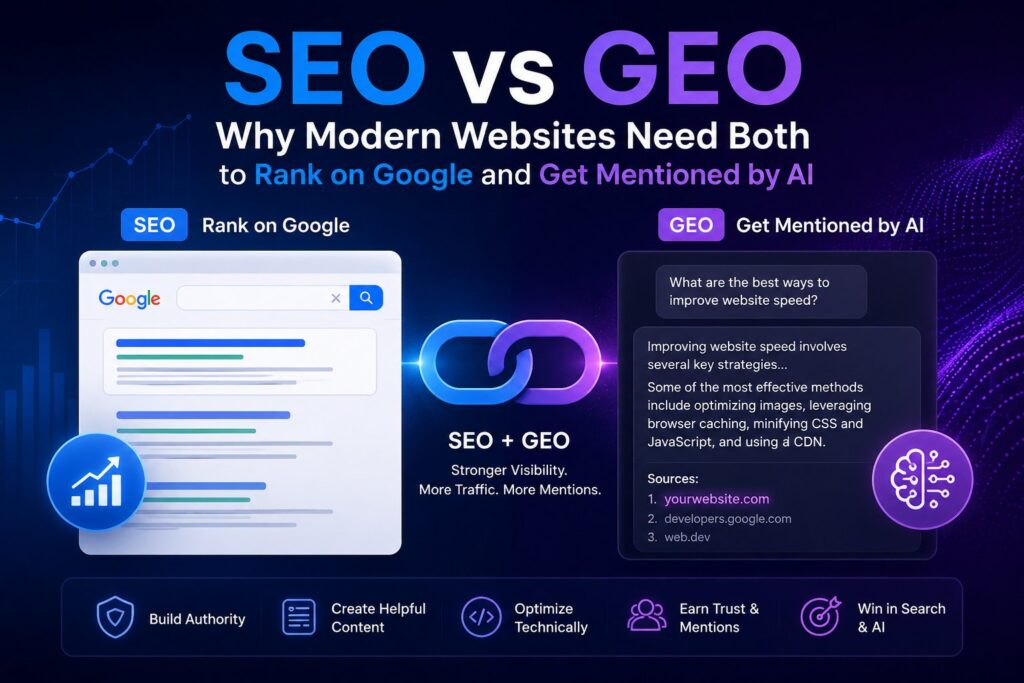
For years, digital visibility was relatively simple.
If your website ranked on Google, you received traffic.
Businesses invested heavily in SEO, created content, built backlinks, improved site speed, and optimized pages around keywords. The goal was clear: rank higher and attract more visitors.
But search is changing.
Today, millions of users are asking questions directly to ChatGPT, Gemini, Perplexity, Claude, and Google’s AI Overviews instead of clicking through multiple search results.
Instead of presenting a list of websites, these platforms often generate answers.
And when AI generates an answer, it decides which websites deserve to be cited, referenced, or mentioned.
This shift has given rise to a new discipline: Generative Engine Optimization (GEO).
Some marketers claim GEO will replace SEO.
Others believe GEO is just another marketing buzzword.
The reality lies somewhere in between.
SEO and GEO are not competing strategies. They are becoming increasingly interconnected.
The websites that dominate search over the next decade will be those that understand how to optimize for both.
What Is SEO?
Search Engine Optimization (SEO) is the process of improving a website’s visibility in traditional search engines such as Google and Bing.
The objective is straightforward:
When someone searches for a relevant topic, your website appears near the top of the results.
SEO typically involves:
- Technical optimization
- Keyword research
- Content creation
- Internal linking
- Backlink building
- Core Web Vitals improvements
- User experience enhancements
Traditional SEO focuses heavily on helping search engines understand, index, and rank your content.
For over twenty years, this approach has been the foundation of digital marketing.
But the way people search is evolving.
What Is Generative Engine Optimization (GEO)?
Generative Engine Optimization (GEO) focuses on helping content become discoverable, understandable, and reference-worthy for AI systems.
Instead of asking:
“Can Google rank this page?”
GEO asks:
“Can an AI confidently use this page when generating an answer?”
This is an important distinction.
When someone asks ChatGPT:
“What are the best ways to improve website speed?”
The AI does not simply display a search result.
It analyzes available information and generates a response using sources it considers trustworthy and useful.
The question for businesses becomes:
Will your content be among those sources?
That is the core purpose of GEO.
| Factor | SEO | GEO |
|---|---|---|
| Primary Goal | Rank higher in search engines | Get cited and mentioned by AI |
| Success Metric | Rankings and traffic | Mentions and citations |
| User Journey | Search → Click Website | Ask AI → Receive Answer |
| Optimization Focus | Keywords and rankings | Context and answer quality |
| Traffic Source | Google, Bing | ChatGPT, Gemini, Perplexity, AI Overviews |
| Content Format | Search-friendly | AI-comprehensible |
| Importance Today | Essential | Increasingly Essential |
SEO vs GEO: What’s the Difference?
Although SEO and GEO overlap significantly, they optimize for different outcomes.
SEO focuses on:
- Rankings
- Organic traffic
- Search visibility
- Keyword performance
- Click-through rates
GEO focuses on:
- AI mentions
- Citations
- Source selection
- Content comprehension
- Entity recognition
- AI visibility
Think of it this way:
SEO helps users find your website.
GEO helps AI find your expertise.
One generates clicks.
The other generates mentions.
Increasingly, businesses need both.
Why SEO and GEO Are Closely Connected
| Website Signal | Helps SEO | Helps GEO |
|---|
| Fast Loading Pages | ✓ | ✓ |
| Strong Topical Authority | ✓ | ✓ |
| Clear Heading Structure | ✓ | ✓ |
| Internal Linking | ✓ | ✓ |
| Expert Content | ✓ | ✓ |
| Mobile Friendliness | ✓ | ✓ |
| Technical Accessibility | ✓ | ✓ |
| Backlinks | ✓ | Indirectly |
| Structured Data | ✓ | ✓ |
The biggest misconception surrounding GEO is that it requires an entirely different website strategy. In reality, many of the same signals that help Google trust your website also help AI systems understand and reference it.
Technical accessibility remains important because both search engines and AI systems need to discover and understand content.
GEO often builds upon the same foundations that good SEO has required for years.
1. Authority Matters in Both
Google prefers authoritative websites.
AI systems also prefer authoritative websites.
When your website demonstrates expertise and credibility (EEAT) through quality content, industry relevance, and strong reputation signals, both search engines and AI systems are more likely to trust it.
2. Structure Matters in Both
AI systems struggle with poorly structured content.
Google does too.
Clear headings, logical page hierarchy, concise explanations, and well-organized content improve performance across both ecosystems.
3. Technical Health Matters in Both
If search engines struggle to crawl your site, AI systems often face similar challenges.
Technical SEO remains one of the most important foundations for GEO success.
4. Topical Authority Matters in Both
A website that consistently publishes valuable content around a specific subject develops expertise signals.
Whether the audience is Google or ChatGPT, expertise still matters.
This is why businesses should stop thinking about SEO and GEO as separate projects.
Strong SEO often creates the foundation that GEO depends upon.
Where GEO Goes Beyond Traditional SEO
While GEO builds on SEO principles, it introduces new considerations.
Information Must Be Easier to Extract
AI systems often prefer content that answers questions directly.
Content that buries key insights beneath lengthy introductions may be less useful to generative engines.
Entity Clarity Becomes More Important
AI systems rely heavily on understanding entities such as:
- People
- Companies
- Products
- Locations
- Concepts
The clearer your content defines these entities, the easier it becomes for AI systems to understand and reference them.
Conversational Search Changes Intent
Traditional search might look like:
“best CRM software”
An AI query might be:
“I run a 20-person sales team. Which CRM should I choose and why?”
The second query is more detailed and conversational.
Content designed around real questions often performs better in AI-driven environments.
Citation Readiness Matters
AI systems frequently prefer content that presents facts, explanations, and frameworks in a way that can be easily referenced.
Well-structured content often has an advantage.
Why Businesses Can No Longer Ignore GEO
A few years ago, ranking on Google was often enough.
Today, many users never reach traditional search results.
Instead they:
- Ask ChatGPT
- Use Perplexity for research
- Read Google AI Overviews
- Use Gemini inside Google’s ecosystem
- Ask AI assistants for recommendations
This creates a new visibility challenge.
A website can rank well in Google while receiving very few AI mentions.
Another website may rank lower yet appear frequently in AI-generated responses.
That means traditional SEO metrics no longer tell the entire story.
Businesses need visibility in both environments.
The New Visibility Framework
Layer 1: Technical Foundation
- Crawlability
- Site speed
- Mobile usability
- Security
- Indexability
Layer 2: Traditional Search Visibility
- Rankings
- Organic traffic
- Keyword performance
- Backlinks
Layer 3: AI Visibility
- Mentions
- Citations
- Entity understanding
- Source trustworthiness
- AI readiness
Many businesses actively monitor Layer 1 and Layer 2.
Very few currently evaluate Layer 3.
That creates an opportunity for early adopters.
| GEO Signal | Why It Matters |
|---|
| Entity Clarity | Helps AI understand who and what is being discussed |
| Answer Quality | Makes content easier to reference |
| Citation Readiness | Increases likelihood of AI mentions |
| Topic Relationships | Helps AI understand context |
| Conversational Coverage | Matches how users interact with AI |
| Source Transparency | Builds trustworthiness |
| Expert Attribution | Strengthens authority signals |
Many businesses actively monitor Layer 1 and Layer 2. Very few currently evaluate Layer 3. That creates an opportunity for early adopters.
Modern website visibility now consists of three layers.
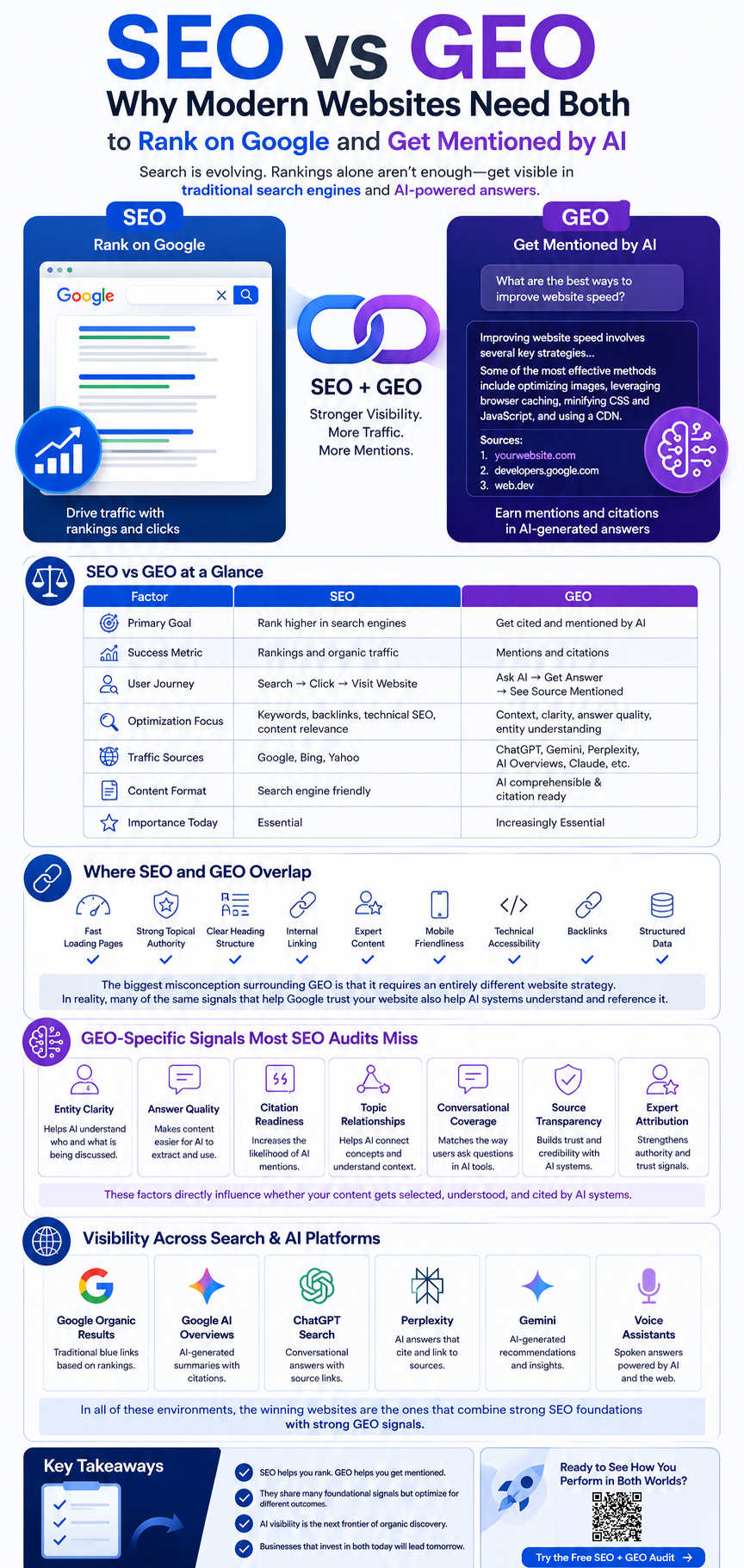
SEO vs GEO Visual Guide (infographic)
How to Measure SEO and GEO Readiness
One of the biggest challenges in GEO is understanding where your website currently stands.
SEO has mature tools that measure:
- Rankings
- Backlinks
- Technical issues
- Traffic trends
GEO introduces new questions:
- Can AI understand my content?
- Are important entities clearly defined?
- Is my content structured for citation?
- Does my content answer questions directly?
- Does my website demonstrate expertise clearly enough?
These are not questions traditional SEO audits typically answer.
To help businesses evaluate both traditional search visibility and AI visibility together, we created a free SEO + GEO audit tool.
Rather than focusing solely on rankings, it reviews both classic SEO fundamentals and emerging AI-readiness signals, helping identify areas that may affect search performance as well as AI discoverability.
You can try the SEO + GEO audit here.
The goal is not to replace traditional SEO analysis, but to provide a broader picture of how a website performs in today’s evolving search landscape.
The Future Is Not SEO or GEO. It’s SEO and GEO.
Every major shift in search creates new winners and losers.
When mobile search emerged, businesses that adapted early gained a significant advantage.
When page speed became a ranking factor, fast websites pulled ahead.
The rise of AI-driven discovery represents the next major transition.
The businesses that prepare now will have time to build authority, improve content structures, strengthen entity signals, and increase their chances of being cited by AI systems.
The businesses that wait may eventually find themselves invisible in places where users increasingly spend their time.
| Visibility Type | What Users See |
|---|
| Google Organic Results | Website links |
| Google AI Overviews | AI-generated answers with citations |
| ChatGPT Search | Summarized responses with references |
| Perplexity | AI answers citing sources |
| Gemini | AI-generated recommendations |
| Voice Assistants | Spoken answers |
In all of these environments, the winning websites are increasingly the ones that combine strong SEO foundations with strong GEO signals.
Final Thoughts
SEO is not dying.
GEO is not replacing SEO.
Instead, the two are becoming deeply connected.
SEO helps search engines discover and rank your content.
GEO helps AI systems understand and reference your content.
One drives rankings.
The other drives mentions.
Together, they determine how visible your business will be in the next generation of search.
The question is no longer whether SEO or GEO matters more.
The real question is whether your website is prepared for both.
