

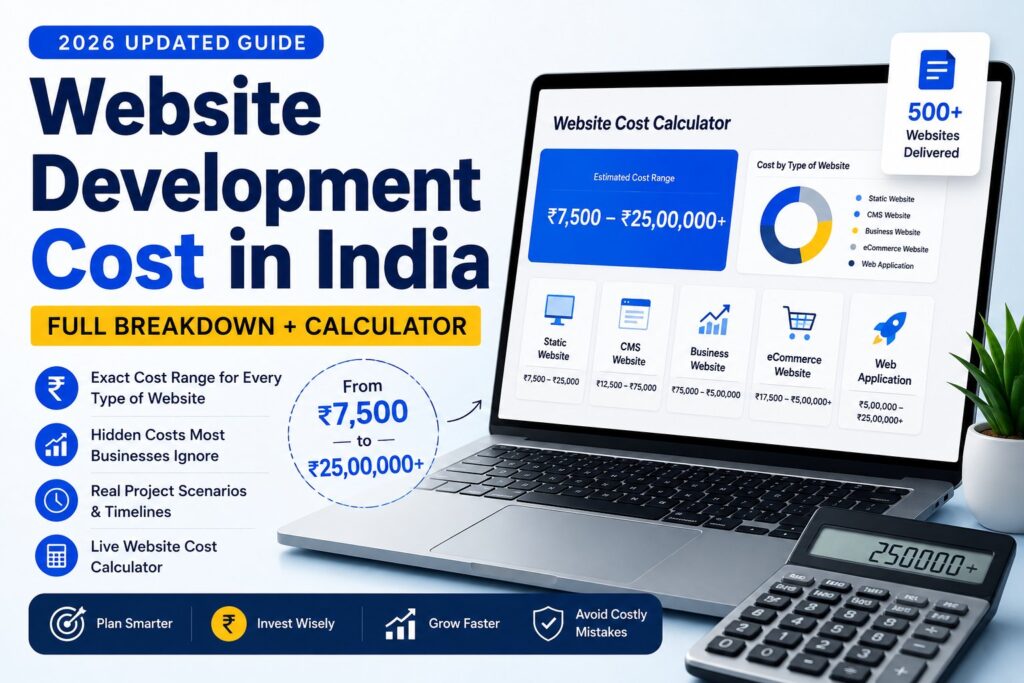
A website in India can cost ₹7,500.
The same website can also cost ₹5,00,000.
Both numbers are correct.
So what actually determines the real cost?
If you’ve been researching website development cost in India, you’ve probably seen wildly different pricing. One freelancer quotes ₹15,000. An agency quotes ₹1.2 lakhs. A web app company talks about ₹10 lakhs.
It’s confusing.
And if you make the wrong decision, it can cost you more in the long run than the website itself.
This guide eliminates that confusion.
Based on experience delivering 500+ websites across industries — from small local businesses to enterprise-grade platforms — this is a transparent, no-fluff breakdown of what a website truly costs in India in 2026.
You’ll discover:
• The exact cost range for every type of website
• What drives pricing up (and what doesn’t)
• Hidden costs most agencies don’t mention
• Freelancer vs Agency cost differences
• Real project cost scenarios
• Ongoing maintenance and marketing expenses
• A live website cost calculator to estimate your budget
Whether you’re a startup founder, a small business owner, or a scaling enterprise, this page will help you answer one critical question:
Not “How much does a website cost?”
But:
“How much should my website cost based on my goals?”
Let’s break it down.
- The Real Cost of Building a Website in India (2026 Overview)
- Website Cost Calculator
- Website Cost by Type (Quick Comparison)
- What Actually Drives Website Cost?
- Hidden Costs Most Businesses Ignore
- The Real Cost Formula
- Cost Comparison: DIY vs Freelancer vs Agency
- Real Project Cost Examples (Case Scenarios)
- Website Cost vs ROI: Is It an Expense or Investment?
- 7 Website Cost Mistakes That Make Businesses Overpay
- How to Decide the Right Budget for Your Business
- Frequently Asked Questions About Website Development Cost in India
- Explore Detailed Pricing Guides
- Conclusion: What a Website Should Really Cost You
The Real Cost of Building a Website in India (2026 Overview)
Let’s get straight to the numbers.
The cost of website development in India in 2026 typically ranges between:
₹7,500 to ₹25,00,000+
That’s a massive range.
Here’s why.
Website pricing depends on the type of website, features required, level of customization, and the team you hire. A simple 5-page static site is vastly different from a custom-built eCommerce platform or web application.
To simplify things, here’s a quick overview.
Quick Cost Summary (India – 2026)
| Website Type | Typical Cost Range (INR) | Best For |
|---|---|---|
| Basic Static Website (4–5 pages) | ₹7,500 – ₹25,000 | Students, portfolios, small local businesses |
| Small Business Dynamic Website (CMS) | ₹12,500 – ₹75,000 | Service businesses, consultants, startups |
| Professional Business Website (Custom Design) | ₹75,000 – ₹5,00,000 | Growing brands, multi-location businesses |
| Basic eCommerce Website | ₹17,500 – ₹1,25,000 | Small online stores |
| Advanced eCommerce Platform | ₹1,25,000 – ₹5,00,000+ | Large product catalogs, scaling brands |
| Custom Web Application | ₹5,00,000 – ₹25,00,000+ | SaaS, enterprise systems, automation platforms |
Now let’s simplify this further.
If Your Budget Is…
Under ₹25,000
You’re looking at a template-based website with limited customization. Ideal for basic presence, not heavy marketing.
₹25,000 – ₹1,00,000
You can build a professionally designed CMS website with lead generation features, SEO setup, and scalability.
₹1,00,000 – ₹5,00,000
You’re entering serious business territory. Expect custom design, advanced features, integrations, and conversion-focused architecture.
₹5,00,000+
You’re building a scalable digital asset — eCommerce engine, SaaS platform, booking system, marketplace, or automation-based system.
Why Is There Such a Huge Price Difference?
Because not all websites are built the same.
Two websites may look similar on the surface but differ massively in:
• Backend architecture
• Scalability
• Security
• Speed optimization
• SEO structure
• Integration capabilities
• Conversion strategy
A ₹20,000 website is usually built for presence.
A ₹2,00,000 website is built for growth.
That distinction changes everything.
What Most People Get Wrong
Many business owners search:
“How much does a website cost in India?”
But that’s the wrong question.
The right question is:
“What type of website do I actually need?”
Once you understand that, pricing becomes clear.
In the next section, we’ll break down website cost by type so you can identify exactly where your project fits.
Website Cost Calculator
Easily calculate the cost of your business website or eCommerce website with our user-friendly website cost calculator tool.
Get an online estimate now!
(in INR & USD)
Quick, Online & Accurate
Website Cost by Type (Quick Comparison)
Not all websites are built for the same purpose.
Some are built just to establish presence.
Some are built to generate leads.
Some are built to sell products.
Some are built to run entire businesses.
Your cost depends on which category you fall into.
Below is a quick comparison to help you identify your type.
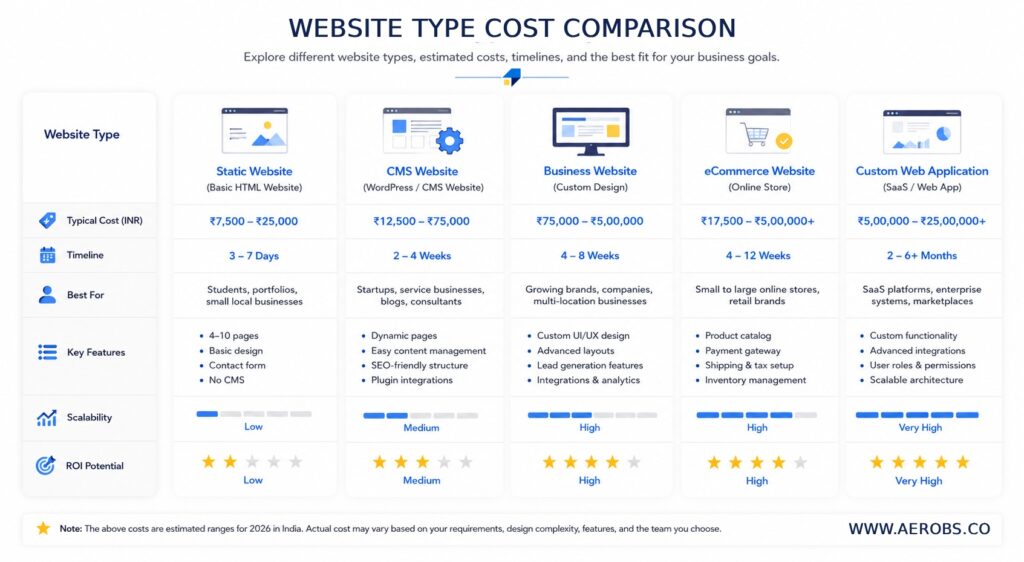
1. Static Website Cost (Basic HTML Website)
Typical Cost: ₹7,500 – ₹25,000
Best For: Students, freelancers, small local businesses
Pages: 4–10
Technology: HTML/CSS or basic template
A static website is the most basic form of a website. The content does not change dynamically, and there is usually no admin panel.
What You Typically Get:
- 4–5 essential pages (Home, About, Services, Contact)
- Contact form
- Basic mobile responsiveness
- Template-based design
Limitations:
- No content management system
- Difficult to scale
- Not ideal for ongoing SEO
- Minimal customization
This is ideal if you only need a digital visiting card.
2. Small Business Dynamic Website (CMS-Based)
Typical Cost: ₹12,500 – ₹75,000
Best For: Service businesses, consultants, clinics, agencies
Technology: WordPress, Wix, or similar CMS
This is the most common website type in India.
It includes a content management system (CMS), allowing you to edit content, add blog posts, and scale over time.
What You Typically Get:
- 5–25 pages
- Admin panel access
- SEO-friendly structure
- Blog functionality
- Lead forms and integrations
- Google Maps and chat integration
This type of website is built for visibility and lead generation.
For most small to mid-sized businesses, this is the ideal balance between cost and scalability.
3. Professional Business Website (Custom Design + Advanced Features)
Typical Cost: ₹75,000 – ₹5,00,000
Best For: Growing brands, multi-location businesses, funded startups
Technology: Advanced WordPress, custom CMS, or hybrid stack
This is where strategy begins to matter more than just design.
These websites are built with conversion architecture, custom UI/UX, and stronger backend optimization.
What You Typically Get:
- Custom-designed interface
- Conversion-focused layout
- CRM integrations
- Advanced forms and automation
- Speed optimization
- Enhanced security setup
- Structured SEO foundation
These websites are not just informational.
They are built as revenue-generating assets.
4. Basic eCommerce Website
Typical Cost: ₹17,500 – ₹1,25,000
Best For: Small online stores (up to 100 products)
Technology: WooCommerce, Shopify, basic Magento setup
An eCommerce website allows you to sell products online with payment gateway integration.
What You Typically Get:
- Product catalog setup
- Shopping cart
- Payment gateway integration
- Order management
- Basic shipping setup
- Customer login system
This is suitable for businesses testing online sales or launching a small product line.
5. Advanced eCommerce Platform
Typical Cost: ₹1,25,000 – ₹5,00,000+
Best For: Scaling brands, multi-category stores, serious online businesses
Technology: Advanced WooCommerce, Shopify Plus, Magento, custom stack
This category focuses heavily on performance, automation, and scalability.
What You Typically Get:
- Advanced product filtering
- Inventory management integration
- Custom checkout flows
- Multi-vendor support (if required)
- Marketing automation
- Analytics and reporting dashboards
- Performance optimization for high traffic
This is where eCommerce becomes infrastructure, not just a store.
6. Custom Web Application or Enterprise Website
Typical Cost: ₹5,00,000 – ₹25,00,000+
Best For: SaaS platforms, marketplaces, booking engines, automation systems
Technology: Custom stack (React, Node, Laravel, Django, etc.)
This is not a “website” in the traditional sense.
It is software built for the web.
What You Typically Get:
- Custom dashboards
- Role-based user access
- API integrations
- Complex database architecture
- Automation systems
- High-security implementation
- Scalable cloud infrastructure
These projects require planning, architecture design, QA testing, and long-term maintenance strategy.
Quick Decision Guide
If you need an online presence → Static Website
If you need lead generation → Dynamic CMS Website
If you need brand positioning + conversions → Professional Business Website
If you need to sell products → eCommerce Website
If you need automation or software functionality → Custom Web Application
Most businesses overpay because they build more than they need.
Most businesses underperform because they build less than they need.
In the next section, we’ll break down what actually drives website cost so you can understand where your money really goes.
What Actually Drives Website Cost?
Two websites can look similar on the surface.
One costs ₹25,000.
The other costs ₹2,50,000.
The difference is rarely “just design.”
Website pricing is determined by a combination of technical depth, strategic planning, and long-term scalability.
Here are the real cost drivers.
1. Design Complexity and Customization
Design is not just about colors and fonts.
It includes:
- Custom UI/UX planning
- Wireframing and user journey mapping
- Mobile-first optimization
- Animation and interaction design
- Conversion-focused layouts
A template-based website is cheaper because the structure already exists.
A custom-designed website requires research, wireframes, revisions, and unique layouts built from scratch.
More customization = more design hours = higher cost.
2. Features and Functionalities
Features are one of the biggest cost multipliers.
Basic website features:
- Contact form
- Image gallery
- Basic blog
Advanced features:
- User login dashboards
- Booking systems
- Payment gateways
- CRM integration
- Inventory management
- Multi-language support
- API integrations
Each additional feature increases development time, testing requirements, and maintenance complexity.
The more interactive your website becomes, the more engineering it requires.
3. Technology Stack
The platform you choose significantly impacts pricing.
CMS platforms like WordPress or Shopify reduce development time because much of the structure is pre-built.
Custom stacks using technologies like React, Laravel, or Django require backend architecture, database design, and deployment configuration.
Custom development increases:
- Development time
- Testing complexity
- Long-term maintenance needs
For most business websites, a CMS is sufficient.
Custom stacks are typically required for SaaS platforms, marketplaces, or highly customized systems.
WordPress powers a significant percentage of websites worldwide, making it one of the most popular CMS platforms for businesses seeking flexibility and scalability.
4. Content Requirements
Content is often underestimated.
Costs increase if you need:
- Professional copywriting
- SEO-optimized blog content
- Product descriptions
- Brand messaging strategy
- Custom photography or videography
A website with placeholder content is cheaper.
A website built to convert visitors into customers requires professionally structured content.
5. SEO and Performance Optimization
Some websites are built just to “exist.”
Others are built to rank and convert.
If SEO is included during development, it may involve:
- Technical SEO structure
- Schema markup
- Page speed optimization
- On-page keyword mapping
- Internal linking architecture
These require planning and expertise.
A cheaper website often ignores these elements, leading to higher long-term marketing costs.
Google’s own documentation recommends focusing on technical SEO fundamentals, page experience, crawlability, and helpful content rather than relying solely on keywords.
Website speed directly impacts user experience and conversion rates. Google’s PageSpeed Insights can be used to measure and improve website performance.
6. Scalability and Future Growth
This is where most cost differences hide.
A basic website may work today but struggle when:
- Traffic increases
- More products are added
- New integrations are required
- Automation becomes necessary
A scalable website includes:
- Clean code structure
- Flexible database design
- Hosting optimized for growth
- Modular architecture
Building scalability early costs more upfront, but saves money later.
7. Developer Type: DIY vs Freelancer vs Agency
Who builds your website affects cost significantly.
DIY:
- Lowest cost
- Highest time investment
- Limited expertise
Freelancer:
- Moderate cost
- Depends heavily on individual skill
- Limited team support
Agency:
- Higher upfront cost
- Structured process
- Dedicated designers, developers, QA, and project managers
- Long-term support
The price difference reflects team structure, reliability, and quality control.
8. Ongoing Maintenance and Support
Website development is not a one-time event.
Costs continue after launch in the form of:
- Hosting renewals
- Security updates
- Plugin licensing
- Bug fixes
- Backup management
- Technical support
A website that is actively maintained performs better and lasts longer.
Ignoring maintenance often results in higher repair costs later.
The Core Truth
Website cost is not determined by “pages.”
It is determined by:
- Strategy
- Customization
- Functionality
- Scalability
- Support
If your goal is only online presence, your cost will stay low.
If your goal is growth, automation, and long-term performance, your investment increases accordingly.
In the next section, we’ll uncover the hidden costs most businesses overlook before starting their website project.
Hidden Costs Most Businesses Ignore
Most business owners budget only for “website development.”
That is mistake number one.
Because the invoice you receive at launch is rarely the final amount you’ll spend.
Websites have ongoing and indirect costs that many agencies don’t clearly explain upfront.
If you don’t account for these, your “₹50,000 website” can quietly become a ₹2,00,000 project over time.
Let’s break down the hidden costs.
1. Domain Renewal
A domain is not a one-time purchase.
It is renewed annually.
Typical cost:
- ₹500 – ₹2,500 per year (depending on extension and provider)
Premium domains can cost significantly more.
It’s small, but it’s recurring.
Domain pricing varies based on extension, registrar, and renewal policies. You can compare current domain registration and renewal costs from accredited registrars and industry resources such as ICANN.
2. Hosting Upgrades
Most businesses start with shared hosting.
As traffic grows, performance issues begin.
You may need:
- VPS hosting
- Cloud hosting
- Dedicated servers
Costs can increase from:
₹1,500/year → ₹30,000–₹1,00,000+ per year
Growth requires better infrastructure.
3. SSL, Security & Backups
Many hosting providers offer basic SSL for free.
But advanced security solutions may include:
- Premium SSL certificates
- Malware protection
- Firewall services
- Automated backups
- Monitoring tools
These can cost anywhere between:
₹3,000 – ₹25,000 annually (or more for high-traffic sites)
Security becomes critical as your business grows.
Google recommends HTTPS as a security best practice because it encrypts communication between users and websites and helps build trust.
4. Premium Plugins, Themes & Licensing
Many CMS websites rely on third-party tools.
Examples:
- Form builders
- Page builders
- SEO tools
- Booking systems
- eCommerce extensions
Some are one-time purchases.
Others require yearly renewal fees.
These can add:
₹5,000 – ₹50,000 per year depending on features.
Small recurring fees compound over time.
5. Content Creation & Updates
A website without fresh content slowly loses visibility.
You may need:
- Blog writing
- Product updates
- Landing pages
- SEO content
- Graphic updates
Content writing in India can cost:
₹1,000 – ₹5,000 per 1000 words
If you publish regularly, this becomes a recurring investment.
6. SEO & Marketing Costs
This is the biggest hidden cost.
Many assume once the website is live, customers will come.
They don’t.
SEO services typically range:
₹8,500 – ₹75,000+ per month
Paid ads:
Budget dependent
Social media management:
₹10,000+ per month
Your website is the engine.
Marketing is the fuel.
Without fuel, the engine does nothing.
7. Maintenance & Technical Support
Websites require:
- Software updates
- Bug fixes
- Compatibility checks
- Performance optimization
- Database cleanup
Maintenance retainers typically range:
₹5,000 – ₹30,000 per month
Skipping maintenance increases long-term repair costs.
8. Redesign & Upgrade Costs
Technology changes quickly.
Design trends evolve.
User expectations shift.
Most business websites need redesign every 3–5 years.
That means reinvestment.
Planning for long-term evolution prevents sudden budget shocks.
The Real Cost Formula
True Website Cost =
Development Cost
- Annual Infrastructure Cost
- Maintenance
- Content
- Marketing
This is why two businesses with the “same website” often experience completely different financial outcomes.
One budgets only for development.
The other budgets for growth.
In the next section, we’ll compare DIY vs Freelancer vs Agency so you can decide where your investment actually delivers value.
Cost Comparison: DIY vs Freelancer vs Agency
One of the biggest factors affecting website cost in India is who builds it.
The same website can cost ₹10,000… or ₹2,00,000… depending entirely on the provider.
But the difference isn’t just price.
It’s process, reliability, scalability, and long-term outcomes.
Let’s break it down clearly.
1. DIY (Do-It-Yourself Website)
Typical Cost: ₹0 – ₹10,000
Best For: Individuals, hobby projects, very small businesses
Platforms: Wix, Squarespace, WordPress.com, Shopify basic plans
DIY websites are built using drag-and-drop builders or pre-designed templates.
What You Save:
- Development charges
- Agency fees
- Project management costs
What You Invest Instead:
- Your time
- Learning curve
- Trial and error
- Technical troubleshooting
Hidden Risks:
- Weak SEO structure
- Slow performance
- Limited scalability
- Poor conversion design
- Security misconfiguration
DIY works if your goal is simple online presence.
It rarely works if your goal is serious growth.
2. Hiring a Freelancer
Typical Cost: ₹10,000 – ₹80,000
Best For: Small businesses with moderate budgets
Structure: One person handling design + development
Freelancers are independent professionals.
They are more affordable than agencies because they operate alone.
Advantages:
- Lower cost
- Flexible communication
- Faster decision-making
- Suitable for smaller projects
Limitations:
- Limited bandwidth
- No backup team
- Depends heavily on individual skill level
- Process may not be structured
- Long-term support may be uncertain
If the freelancer is highly skilled, the result can be excellent.
If not, quality and scalability may suffer.
The outcome depends entirely on the individual.
3. Hiring a Web Development Agency
Typical Cost: ₹20,000 – ₹5,00,000+
Best For: Growth-focused businesses, startups, scaling brands
Structure: Team-based execution
Agencies operate with structured workflows.
Typically, your project may involve:
- UI/UX designer
- Frontend developer
- Backend developer
- SEO specialist
- Project manager
- QA tester
Advantages:
- Structured planning process
- Quality assurance testing
- Better scalability
- Dedicated support
- Long-term maintenance options
- Strategic input beyond just development
Why It Costs More:
- Team involvement
- Project management overhead
- Quality control layers
- Documentation and process
You’re not just paying for coding.
You’re paying for systemized execution.
Quick Comparison Table
| Factor | DIY | Freelancer | Agency |
|---|---|---|---|
| Cost | Lowest | Moderate | Higher |
| Expertise | Self-learned | Individual skill | Team expertise |
| Scalability | Limited | Moderate | High |
| Support | Self-managed | Limited | Structured |
| Process | Informal | Varies | Standardized |
| Best For | Basic presence | Small projects | Growth-focused businesses |
Which Option Is Right for You?
Choose DIY if:
- Budget is extremely limited
- Website is non-critical
- You’re willing to invest time learning
Choose Freelancer if:
- You need affordability
- Project scope is moderate
- You’re comfortable managing coordination
Choose Agency if:
- Website is core to revenue
- You want scalability
- You need strategy, not just design
- Long-term support matters
The Strategic Perspective
A website is not just an expense.
It’s infrastructure.
If your business depends on online leads, online sales, or digital credibility, choosing purely based on lowest cost can become expensive later.
In the next section, we’ll look at real project cost examples so you can see how budgets translate into actual business scenarios.
Real Project Cost Examples (Case Scenarios)
Understanding pricing in theory is helpful.
But real clarity comes from seeing how budgets translate into actual business scenarios.
Below are realistic examples based on typical projects in India. These will help you identify where your business fits.
Scenario 1: Local Service Business (Lead Generation Focus)
Business Type: Local Gym / Dental Clinic / Solopreneurs
Goal: Generate inquiries and phone calls
Budget Range: ₹25,000 – ₹60,000
What This Budget Covers:
- 8–15 page CMS website
- Mobile-optimized design
- SEO-ready structure
- Contact forms + WhatsApp integration
- Google Maps integration
- Basic on-page SEO setup
- Speed optimization
Why It Works:
This setup focuses on visibility and lead capture.
It avoids unnecessary complexity and prioritizes conversion-focused pages like:
- Services
- Testimonials
- Location
- Contact
For most small businesses, this is the ideal cost-to-result balance.
Scenario 2: Growing Brand or Multi-Location Business
Business Type: Education institute / hospital / manufacturing firm
Goal: Authority positioning + structured lead management
Budget Range: ₹75,000 – ₹2,50,000
What This Budget Covers:
- Custom-designed UI/UX
- 20–40 structured pages
- Blog setup
- CRM integration
- Lead tracking forms
- Advanced SEO architecture
- Performance optimization
- Security configuration
Why It Costs More:
- Custom layouts require design hours
- CRM integration requires backend logic
- Structured SEO planning requires research
This type of website becomes a digital marketing asset rather than just a digital brochure.
Scenario 3: Small eCommerce Startup
Business Type: Clothing brand / electronics store / niche products
Goal: Sell products online
Budget Range: ₹80,000 – ₹2,00,000
What This Budget Covers:
- Product catalog (50–300 products)
- Payment gateway integration
- Shipping configuration
- Order management dashboard
- Customer login system
- Basic marketing integrations
- Speed and checkout optimization
Cost Drivers:
- Number of products
- Payment gateway setup
- Custom checkout features
- Automation tools
This budget is suitable for businesses testing or scaling online sales.
Scenario 4: Scaling eCommerce Brand
Business Type: Multi-category store / marketplace
Goal: High traffic + automation + analytics
Budget Range: ₹2,00,000 – ₹6,00,000+
What This Budget Covers:
- Advanced filtering system
- Inventory integration
- Custom checkout logic
- Multi-location shipping
- Marketing automation
- Analytics dashboard
- Performance optimization for high traffic
At this level, infrastructure matters.
Performance, uptime, and scalability become business-critical.
Scenario 5: SaaS or Custom Web Application
Business Type: Startup platform / booking engine / CRM system
Goal: Deliver software via web
Budget Range: ₹5,00,000 – ₹25,00,000+
What This Budget Covers:
- Custom frontend and backend development
- Database architecture
- Role-based user access
- API integrations
- Security implementation
- QA testing cycles
- Deployment and cloud setup
This is no longer “website development.”
It is software engineering.
Costs depend heavily on:
- Feature depth
- Automation complexity
- Data structure
- Security needs
What These Examples Reveal
Website pricing becomes predictable once you identify:
- Your business size
- Your revenue model
- Your traffic expectations
- Your growth ambition
Most businesses fall between ₹30,000 and ₹2,00,000.
Only businesses requiring automation, eCommerce scaling, or software systems move into higher brackets.
The mistake many businesses make is building either:
Too small for their ambition
Or
Too large for their current stage
In the next section, we’ll help you decide the right budget range for your specific business goals using a clear decision framework.
Website Cost vs ROI: Is It an Expense or Investment?
Most business owners look at website development like a bill.
Smart business owners look at it like an asset.
The difference between those two mindsets determines whether your website becomes a cost center or a revenue engine.
Let’s break this down with real numbers.
Step 1: Understand Revenue Potential
Imagine this scenario:
- Your average customer value = ₹25,000
- Your website generates 20 qualified leads per month
- Your conversion rate = 10%
That means:
20 leads × 10% conversion = 2 customers per month
2 customers × ₹25,000 = ₹50,000 revenue per month
That’s ₹6,00,000 per year.
Now ask yourself:
If a professionally built ₹1,50,000 website helps generate that revenue, is it expensive?
Or is it underpriced?
Step 2: Compare Cost vs Lifetime Value
Let’s take another example.
If your business operates for 5 years on the same website:
Website Cost: ₹1,50,000
Spread over 5 years = ₹30,000 per year
That’s ₹2,500 per month.
If your website brings even one extra customer per month, it likely pays for itself.
This is why serious businesses treat websites as infrastructure.
Step 3: The Real Cost of Underinvesting
Many businesses choose the lowest quote.
But here’s what happens:
- Weak SEO structure → higher ad costs
- Poor conversion design → lower lead quality
- Slow performance → lost visitors
- Limited scalability → rebuild in 2 years
A ₹30,000 website that needs rebuilding later often becomes more expensive than building it properly once.
Cheap upfront can become expensive long term.
Step 4: Cost vs Customer Acquisition
Think of your website as your digital salesperson.
If hiring a physical salesperson costs:
₹20,000 – ₹40,000 per month salary
And your website costs ₹1,00,000 one time…
Which is more economical over 3 years?
Your website works:
- 24/7
- Without salary
- Without incentives
- Without leave
- Without fatigue
That changes the comparison completely.
Step 5: When It Truly Is an Expense
A website becomes an expense when:
- It has no marketing strategy
- It has no SEO plan
- It has no traffic source
- It has no conversion structure
- It’s built without business goals
In that case, even ₹20,000 is wasted.
ROI depends more on strategy than cost.
The Investment Formula
Website ROI depends on:
Traffic × Conversion Rate × Customer Value
If any one of these improves because of better design, structure, or performance, your returns multiply.
This is why:
A ₹2,00,000 website with strong conversion architecture can outperform a ₹50,000 website by 5x or 10x.
Final Perspective
The real question is not:
“How do I build the cheapest website?”
It’s:
“How do I build a website that produces returns?”
When you evaluate website cost through ROI, pricing becomes logical.
And logical investments are easier to commit to than emotional expenses.
7 Website Cost Mistakes That Make Businesses Overpay
Most businesses don’t overspend because websites are expensive.
They overspend because they make the wrong decisions early.
Avoiding these mistakes can save you lakhs — and years of frustration.
1. Choosing the Cheapest Quote Without Comparing Scope
A ₹20,000 quote and a ₹1,20,000 quote are rarely for the same thing.
Cheaper proposals often exclude:
- SEO structure
- Speed optimization
- Security setup
- Proper hosting configuration
- Conversion strategy
Always compare scope, not just price.
Low cost without clarity often becomes high cost later.
2. Building for Today Instead of Planning for Growth
Many businesses say:
“We just need something basic for now.”
Two years later:
- They want eCommerce
- They want automation
- They want SEO scaling
- They want integrations
And the website can’t handle it.
Result: Full rebuild.
Planning for scalability may increase initial cost slightly — but prevents complete reinvestment later.
3. Paying for Custom Development When a CMS Would Work
Not every business needs a custom-coded platform.
If your website:
- Displays services
- Collects leads
- Publishes blogs
- Sells limited products
A CMS like WordPress is usually sufficient.
Overengineering inflates cost unnecessarily.
4. Using a Template When Brand Positioning Requires Custom Design
The opposite mistake also happens.
Some businesses choose low-cost templates when they need:
- Strong brand positioning
- Premium perception
- High-ticket client acquisition
A generic template for a luxury brand weakens credibility.
Underinvesting in positioning can cost far more in lost revenue.
5. Ignoring Conversion Strategy
Many websites look good but don’t convert.
Common issues:
- No clear call to action
- Poor page hierarchy
- Weak trust signals
- Slow loading speed
- Confusing navigation
Without conversion planning, traffic doesn’t translate into revenue.
And then businesses blame marketing instead of structure.
6. Not Budgeting for Marketing After Development
This is one of the most common mistakes.
Businesses spend ₹1,00,000 building a website.
Then allocate ₹0 for SEO, ads, or content.
A website without traffic produces no ROI.
Budgeting only for development — without marketing — makes even a great website underperform.
7. Skipping Maintenance to “Save Money”
To cut costs, some businesses skip:
- Updates
- Security patches
- Backups
- Performance monitoring
Until something breaks.
Emergency fixes often cost far more than regular maintenance.
Small monthly investments prevent large unexpected expenses.
The Core Pattern Behind These Mistakes
Most overpayment doesn’t happen because of high pricing.
It happens because of:
- Lack of clarity
- Lack of planning
- Lack of long-term thinking
Smart website investment is not about spending more.
It’s about spending correctly.
How to Decide the Right Budget for Your Business
Most people ask:
“How much does a website cost?”
A better question is:
“How much should I invest in a website at my current stage?”
The right budget depends less on industry and more on business maturity, revenue goals, and growth strategy.
Use the framework below to decide.
Step 1: Identify Your Business Stage
Your website investment should match your business stage.
Stage 1: Early Stage / Validation Phase
- New startup
- Testing business idea
- Limited marketing budget
- Low traffic expectations
Recommended Budget: ₹20,000 – ₹60,000
Focus on:
- Clean CMS website
- Clear service pages
- Lead capture forms
- Basic SEO structure
Goal: Validate demand and start generating inquiries.
Avoid: Overbuilding or heavy custom features.
Stage 2: Growth Stage / Structured Lead Generation
- Stable revenue
- Active marketing campaigns
- SEO focus
- Multiple service offerings
Recommended Budget: ₹75,000 – ₹2,00,000
Focus on:
- Custom UI/UX
- Conversion-focused landing pages
- CRM integration
- Advanced performance optimization
- Blog and content architecture
Goal: Improve conversion rate and brand authority.
Avoid: Basic template websites that limit scalability.
Stage 3: Scale Stage / Digital Infrastructure
- High traffic
- Paid ads + SEO running
- Automation needs
- Online sales or dashboards
Recommended Budget: ₹2,00,000 – ₹6,00,000+
Focus on:
- Custom development
- Advanced integrations
- Automation systems
- Analytics dashboards
- Scalable hosting setup
Goal: Build infrastructure, not just design.
Avoid: Underpowered hosting or quick template builds.
Stage 4: Enterprise / Software-Based Model
- SaaS platform
- Marketplace
- Booking engine
- Automation-heavy workflows
Recommended Budget: ₹5,00,000 – ₹25,00,000+
Focus on:
- Full architecture planning
- Backend scalability
- API integrations
- Security and compliance
- QA testing cycles
Goal: Build a digital product, not a brochure site.
Step 2: Consider Revenue Impact
Ask yourself:
Is your website directly responsible for revenue?
If yes, it is an investment, not an expense.
For example:
If your average customer value is ₹25,000
And your website helps you close just 5 extra clients per year
That’s ₹1,25,000 in additional revenue
Suddenly, a ₹1,00,000 website is logical.
Budget should be aligned with expected return.
Step 3: Avoid These Budgeting Mistakes
- Building the cheapest possible website while running expensive ads
- Overspending on design without investing in marketing
- Ignoring scalability and paying again later
- Copying competitors without understanding their stage
Smart budgeting means building for your present — but preparing for your next level.
Quick Budget Decision Guide
If your goal is online presence → ₹20K–₹60K
If your goal is steady lead generation → ₹75K–₹2L
If your goal is scaling online revenue → ₹2L–₹6L+
If your goal is building a digital product → ₹5L+
Clarity reduces overpayment.
Strategy prevents underinvestment.
In the next section, we’ll answer the most frequently asked questions about website development cost in India to clear any remaining doubts.
Frequently Asked Questions About Website Development Cost in India
Below are the most common questions business owners ask before investing in a website. These answers are structured to give you clarity without confusion.
How much does a basic 5-page website cost in India?
A basic 5-page website in India typically costs between ₹15,000 and ₹50,000.
This usually includes:
- Domain and hosting setup
- Mobile-responsive design
- Contact form
- Basic SEO structure
If custom design or advanced features are added, the cost increases.
What is the cost of a WordPress website in India?
A WordPress website in India generally costs:
- ₹12,500 – ₹75,000 for small business sites
- ₹75,000 – ₹2,50,000+ for custom-designed or advanced builds
Cost depends on:
- Customization level
- Premium themes/plugins
- SEO setup
- Integrations
WordPress is popular because it balances flexibility and affordability.
How much does an eCommerce website cost in India?
An eCommerce website in India can cost:
- ₹17,500 – ₹1,25,000 for small stores
- ₹1,25,000 – ₹5,00,000+ for advanced platforms
Key cost drivers:
- Number of products
- Payment gateway setup
- Shipping configuration
- Inventory systems
- Automation and analytics
The more complex your store operations, the higher the cost.
What is the monthly cost of maintaining a website in India?
Website maintenance typically ranges between:
₹5,000 – ₹30,000 per month
This may include:
- Software updates
- Security monitoring
- Backups
- Performance optimization
- Minor content updates
High-traffic or eCommerce websites usually fall on the higher end.
Why do website prices vary so much in India?
Prices vary because websites differ in:
- Design complexity
- Technology stack
- Features and integrations
- Scalability requirements
- Developer expertise
Two websites may look similar visually but differ drastically in backend architecture and performance.
Is it cheaper to hire a freelancer or an agency?
Freelancers generally charge less than agencies.
Typical ranges:
- Freelancer: ₹10,000 – ₹80,000
- Agency: ₹20,000 – ₹5,00,000+
However, agencies provide:
- Structured process
- Team expertise
- QA testing
- Long-term support
The right choice depends on your project size and business goals.
Can I build a website for free?
Yes, using DIY platforms.
However, free websites usually:
- Have limited customization
- Include platform branding
- Offer limited scalability
- May lack strong SEO structure
Free works for experimentation, not long-term growth.
How long does it take to build a website?
Typical timelines:
- Basic website: 1–3 weeks
- Business CMS website: 3–6 weeks
- eCommerce site: 4–8 weeks
- Custom web application: 2–6 months
Timeline depends on scope, revisions, and content readiness.
Is SEO included in website development cost?
Basic on-page SEO setup is often included.
However, ongoing SEO services are usually separate and may cost:
₹8,500 – ₹75,000+ per month
SEO is continuous optimization, not a one-time setup.
What is the most cost-effective type of website for small businesses?
For most small businesses, a CMS-based WordPress website between ₹25,000 and ₹75,000 offers the best balance of:
- Affordability
- Scalability
- SEO readiness
- Customization
It allows growth without heavy upfront investment.
At this point, you now understand:
- What websites cost
- Why pricing varies
- What hidden expenses exist
- How to choose the right budget
In the final section, we’ll summarize everything and help you take the next step confidently.
Explore Detailed Pricing Guides
If you need a deeper breakdown based on your specific requirements, explore these focused guides:
- WordPress Website Cost in India
- Shopify Website Cost in India
- eCommerce Website Development Cost in India
- Website Maintenance Cost in India
- Digital Marketing Packages in India
- SEO Packages in India
Each guide covers pricing variables, feature comparisons, and budgeting insights for that specific category.
Conclusion: What a Website Should Really Cost You
If you’ve read this far, you now understand something most business owners don’t:
There is no single “website cost” in India.
There is only:
- The cost of presence
- The cost of growth
- The cost of infrastructure
And they are completely different things.
The Big Takeaway
A ₹20,000 website is not “cheap.”
A ₹2,00,000 website is not “expensive.”
They are built for different purposes.
If your website is simply a digital brochure, your investment can remain modest.
If your website is your primary sales engine, lead generator, booking system, or online store, it becomes business infrastructure.
Infrastructure is never where you cut corners.
The Real Question You Should Ask
Instead of asking:
“How much does a website cost in India?”
Ask:
“What role will my website play in my business over the next 3 years?”
If it plays a minor role → Keep the investment lean.
If it drives revenue → Invest strategically.
If it runs operations → Build it like software.
Your clarity determines your cost efficiency.
A Smart Way to Think About It
Think of your website like:
- Renting a kiosk (low budget template)
- Leasing a retail store (custom business website)
- Building a factory (eCommerce or web application)
Each serves a different ambition.
Your investment should match your ambition.
Before You Decide
Make sure you are clear on:
- Your business stage
- Your growth plan
- Your marketing strategy
- Your scalability needs
- Your expected return
When those are defined, pricing becomes logical — not emotional.
Want an Exact Estimate for Your Project?
If you want clarity specific to your business:
- Use the website cost calculator
- Or speak with a professional for a custom quotation
A 15-minute clarity conversation can prevent a 2-year technical mistake.
Build smart.
Invest intentionally.
Grow sustainably.

This article gives a very practical breakdown of website development pricing in India and clearly explains the factors that influence overall project costs. It’s especially helpful for startups and businesses trying to balance budget, quality, and scalability while planning their digital presence. Choosing the right development partner is equally important, whether companies want to hire software developers India or hire dedicated developers India for long-term projects and custom solutions
This is awesome, Ahmed! Website costs can be confusing, so this breakdown is super helpful. Bookmarked for future reference!
As a business owner in New Delhi, I can’t recommend the Best Website Designing Company in New Delhi enough! Their expertise transformed our online presence and drove significant growth. Highly recommended
I went through your article which was on website development pricing. I would like to add some easy points which are as follows.
1.Type of Website
2.Design and Customization
3.Functionality
4.Content
5.Responsive Design
6.SEO and Accessibility
7.Maintenance and Updates
8.Hosting and Domain
These are some of the points which I wanted to include in your article. Reades, If you want to know the price of your web development, you can visit an IT company like Alakmalak technologies. They have 17+ years of experience in this field.
While the cost of website development in India can vary depending on your region and the level of service you require, it is usually not too expensive. A good starting point would be to speak with an experienced web designer who can give you a quote based on your specific needs.
Very informative post. Now I know what prices to expect from a freelancer as well as a web design company for my website project. Thanks a ton!