

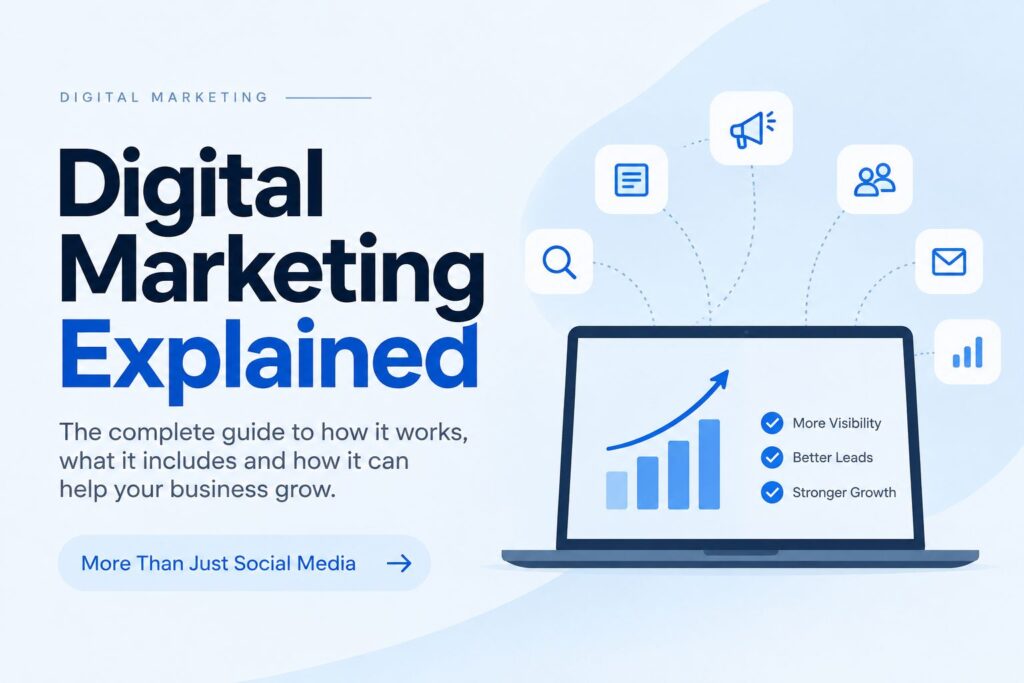
Digital marketing is the use of digital channels, platforms, technology and data to promote a business, connect with potential customers, generate leads, drive sales and build long-term customer relationships.
Unlike traditional marketing, digital marketing allows businesses to reach specific audiences, understand how people interact with their marketing, measure results and continuously improve their campaigns.
Today, digital marketing goes far beyond posting on social media or running Google Ads. It can include search engine optimization (SEO), paid advertising, content marketing, social media, email, WhatsApp marketing, online reputation management, conversion optimization, artificial intelligence (AI), and optimization for emerging AI-powered search experiences.
For businesses, the real value of digital marketing is not simply being visible online. It is creating a connected system that helps the right people discover your business, understand what you offer, trust your brand and ultimately take action.
What Is Digital Marketing?
Digital marketing is the process of using internet-connected channels and digital technologies to market products, services or brands.
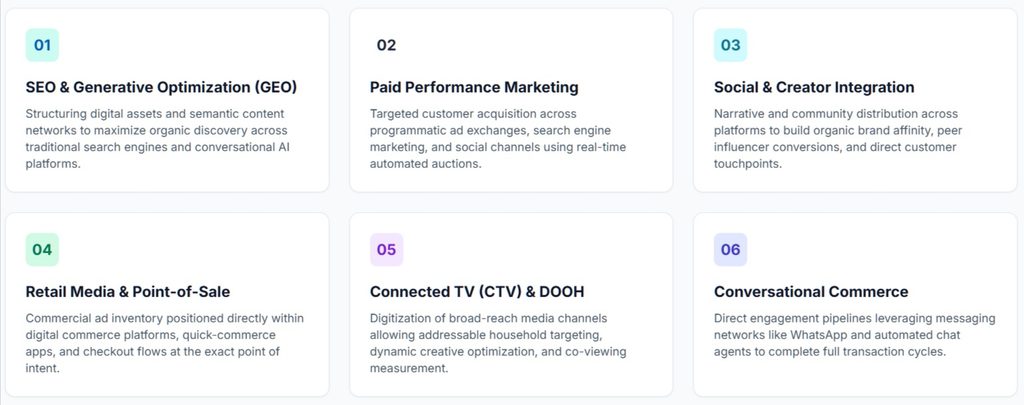
These channels can include:
Search engines
Websites
Social media platforms
Online advertising networks
Email
Messaging platforms
Video and content platforms
E-commerce marketplaces
Mobile applications
AI-powered search and conversational platforms
A useful way to understand digital marketing is to think of it as the complete journey between a potential customer and a business.
Someone might first discover a company through a Google search. They may then visit its website, read an article, watch a video, check reviews, compare alternatives, speak to the company on WhatsApp and eventually make a purchase.
All of those interactions can form part of a digital marketing strategy.
Digital marketing therefore isn’t a single activity or service. It is an ecosystem of interconnected activities designed to attract, engage, convert and retain customers.
How Does Digital Marketing Work?
A successful digital marketing strategy generally follows the customer’s journey rather than focusing on individual marketing channels in isolation.
A simplified customer journey looks like this:
Discover → Visit → Engage → Trust → Enquire → Buy → Return → Recommend
For example, imagine someone searching online for a commercial website development company.
They might:
Search for website development services.
Find a company’s website through organic search or an advertisement.
Read about the company’s services and experience.
Look at its portfolio and customer reviews.
Download a guide or read an article.
Contact the company through a form or WhatsApp.
Speak with a salesperson.
Request a quotation.
Become a customer.
Return later for another service or recommend the business to someone else.
Different digital marketing channels can influence different stages of this journey.
SEO may help the person discover the business. Content marketing can help answer their questions. Reviews can build trust. Paid advertising can bring them back to the website. Conversion optimization can make it easier to enquire. Email or WhatsApp can help nurture the relationship.
The strongest digital marketing strategies therefore connect these activities instead of treating every channel as a separate campaign.
Why Is Digital Marketing Important for Businesses?
Customers increasingly use digital channels to research businesses, compare options, find products and services, communicate with companies and make purchasing decisions.
This has made digital visibility an important part of business development across industries and company sizes.
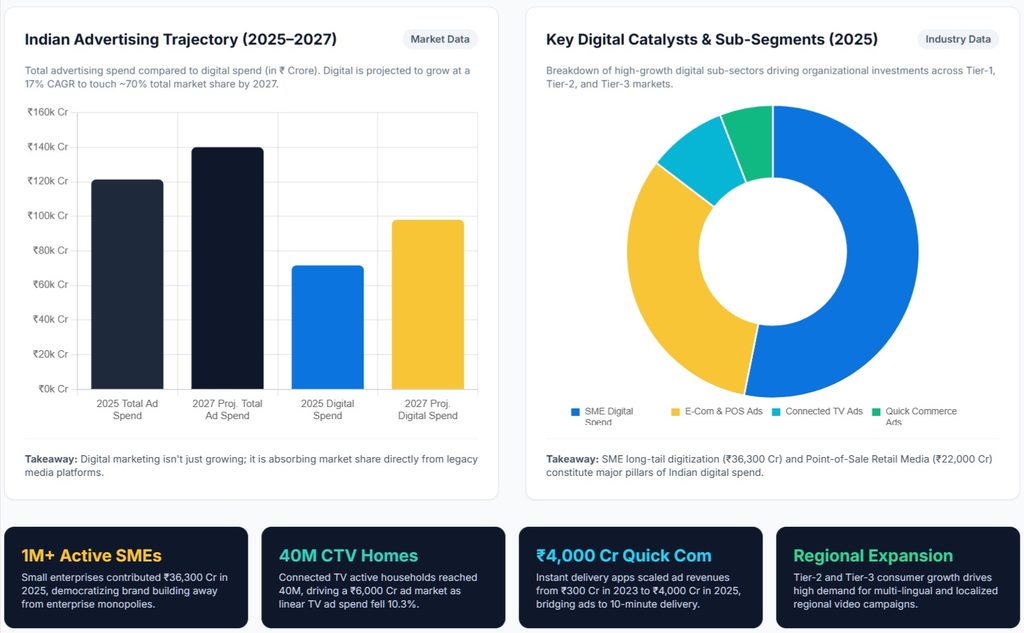
In India, the shift is particularly significant. Digital advertising has become a major part of the country’s advertising ecosystem, while digital media has grown into the largest segment of India’s media and entertainment industry. Recent industry research reported that digital advertising reached ₹947 billion in 2025, representing 63% of total advertising revenues measured in the report.
Digital marketing is important because it can help businesses:
Reach people when they are looking for a solution
Search engines allow businesses to appear when potential customers are actively researching a product, service or problem.
For example, a person searching for “accounting services for startups” has a very different level of intent from someone who simply sees an accounting firm’s advertisement while scrolling through social media.
Reach specific audiences
Digital advertising allows businesses to target audiences using factors such as location, interests, demographics, behaviours and other available signals.
This can make digital campaigns considerably more targeted than many traditional forms of mass advertising.
Build visibility beyond geographical boundaries
A local business can use digital marketing to reach customers in its city, while an e-commerce company can market to customers across the country or internationally.
Search, content, social media and online advertising can allow even relatively small businesses to compete for attention in markets that were previously difficult to reach.
Measure marketing performance
Digital marketing produces measurable signals that can help businesses understand what is working.
Depending on the channel, businesses can measure:
Website visits
Search visibility
Leads
Enquiries
Conversion rates
Advertising costs
Customer acquisition costs
Revenue
Return on ad spend
Engagement
Repeat purchases
This makes it possible to move beyond simply asking, “How many people saw our advertisement?” and instead ask, “How much business did our marketing generate?”
Improve campaigns continuously
Digital marketing is not necessarily a set-and-forget activity.
Businesses can analyse performance, identify weak points, test alternatives and improve campaigns over time.
That ability to continuously learn and optimize is one of the biggest differences between modern digital marketing and traditional mass advertising.
What Are the Different Types of Digital Marketing?
Digital marketing consists of multiple disciplines. The right combination depends on the business, audience, objectives, budget and buying process.
1. Search Engine Optimization (SEO)
Search engine optimization is the process of improving a website and its content so that search engines can understand it and users can discover it through organic search.
SEO can involve:
Keyword and search-intent research
Website structure
Technical SEO
On-page optimization
Content creation
Internal linking
Local SEO
Structured data
Digital authority and reputation
Website performance
SEO is particularly valuable when customers actively search for the products, services or information a business provides.
It is also important to understand that SEO is not simply about inserting keywords into a webpage. Search engines need to understand what a page is about, whether it is useful to users and how it fits into the broader information available online. Google’s SEO Starter Guide
SEO can be a long-term acquisition channel because useful pages can continue attracting relevant visitors without paying for every individual click.
2. Local SEO
Local SEO focuses on helping businesses become more visible when people search for products or services in a particular geographical area.
It is particularly important for:
Restaurants
Clinics
Schools
Hotels
Retail stores
Professional services
Home service providers
Local offices and branches
Other location-dependent businesses
Local SEO can involve optimizing a Google Business Profile, maintaining accurate business information, developing location-specific website content, managing reviews and building relevant local authority.
3. Search Engine Marketing and Pay-Per-Click Advertising
Paid search advertising allows businesses to pay for visibility on search engines and other advertising networks.
Google Ads is one of the best-known examples.
Instead of waiting for a page to gain organic visibility, a business can create an advertising campaign designed to appear for relevant searches.
For example, a company offering industrial machinery could advertise for searches such as:
Industrial machinery manufacturers
CNC machine suppliers
Custom automation systems
Industrial equipment suppliers
Paid search can be particularly effective when there is strong commercial intent.
However, advertising does not automatically make an uncompetitive offer successful. If the landing page is poor, the pricing is unattractive or the business does not meet customer expectations, increasing advertising spend may simply increase the number of people who leave without converting.
4. Social Media Marketing
Social media marketing involves using social platforms to build awareness, engage audiences, distribute content, generate demand and support sales.
It can include:
Organic posts
Short-form videos
Educational content
Brand storytelling
Community management
Influencer collaborations
Social advertising
Lead generation campaigns
Customer service
Social media is particularly useful when a business benefits from visual content, community, personality or repeated exposure.
However, not every business needs to be active on every social platform.
The objective should be to identify where the target audience actually spends time and what type of content works for that audience.
5. Content Marketing
Content marketing involves creating useful information that attracts and helps potential customers.
Content can include:
Blog articles
Guides
Case studies
Videos
Research reports
White papers
Infographics
Webinars
Product comparisons
Tutorials
Industry insights
Content can serve several purposes at once.
It can generate search visibility, answer customer questions, establish expertise, support sales conversations and give other websites or platforms something useful to reference.
The most effective content is not created simply because a business wants to “post something.” It is created because it solves a genuine problem or answers a meaningful question for the intended audience.
6. Email Marketing
Email marketing allows businesses to communicate directly with people who have provided their contact information.
It can be used for:
Lead nurturing
Newsletters
Product announcements
Offers
Educational content
Customer onboarding
Abandoned-cart recovery
Repeat purchases
Customer retention
Email is particularly useful because businesses can build a permission-based communication channel instead of relying entirely on third-party platforms to reach their audience.
7. WhatsApp and Conversational Marketing
Messaging has become an important part of digital customer engagement, particularly in markets where customers are comfortable communicating with businesses through messaging apps.
Businesses can use WhatsApp and other conversational channels for:
Enquiries
Lead qualification
Appointment scheduling
Product recommendations
Customer support
Order updates
Follow-ups
Promotions
Sales conversations
AI can increasingly support these interactions by answering common questions, collecting information and routing qualified enquiries to human teams.
The important distinction is that automation should make communication easier, not make the customer feel as though they are trapped in a conversation with a machine.
8. Influencer and Creator Marketing
Influencer marketing involves working with individuals who have an established audience and influence within a particular community.
Creators can help businesses reach audiences through:
Product demonstrations
Reviews
Tutorials
Sponsored content
Short-form videos
Live content
Recommendations
The right creator is not necessarily the one with the largest audience.
Audience relevance, trust, engagement and alignment with the brand can be more important than follower count.
9. Affiliate Marketing
Affiliate marketing allows businesses to work with third parties who promote their products or services in exchange for a commission or other agreed compensation.
This can be particularly useful for e-commerce businesses, software companies, education providers and other businesses with trackable online transactions.
10. Online Reputation Management
People often research a business before contacting or buying from it.
Reviews, testimonials, news coverage, social discussions and third-party mentions can therefore influence purchasing decisions.
Online reputation management involves monitoring and improving how a business is represented across digital channels.
It may include:
Review management
Customer feedback
Reputation monitoring
Responding to reviews
Correcting inaccurate information
Building credible third-party mentions
Publishing trustworthy information about the business
Reputation is especially important for businesses where trust plays a major role in the buying decision.
11. Conversion Rate Optimization
Getting visitors to a website is only one part of digital marketing.
Conversion rate optimization, or CRO, focuses on improving the percentage of visitors who take a desired action.
That action could be:
Filling out a form
Calling a business
Booking an appointment
Requesting a quotation
Starting a free trial
Making a purchase
Downloading a resource
CRO may involve improving page layouts, headlines, calls to action, forms, navigation, trust signals, pricing presentation, mobile usability and the overall customer journey.
A business can sometimes generate more leads by improving the conversion rate of existing traffic rather than spending more money acquiring additional visitors.
How Do Different Digital Marketing Channels Work Together?
The biggest mistake businesses make is often thinking about digital marketing as a collection of unrelated services.
SEO, Google Ads, social media, content and email can work together.
For example:
SEO brings someone to an article.
↓
Content answers their question.
↓
Website explains the company’s solution.
↓
Case studies and reviews build trust.
↓
CRO makes it easy to enquire.
↓
WhatsApp or email helps follow up.
↓
Sales converts the lead.
↓
Remarketing and retention marketing bring the customer back.
This interconnected approach is often more effective than running isolated campaigns.
SEO, Google Ads, Social Media or Content Marketing: Which Is Best?
There is no universally best digital marketing channel.
The right choice depends on how your customers discover and evaluate your business.
| Channel | Particularly useful for | Typical strength |
|---|---|---|
| SEO | Search-driven businesses | Long-term organic visibility |
| Google Ads | High-intent searches | Faster access to demand |
| Social media | Consumer brands and community-led businesses | Awareness and engagement |
| Content marketing | Complex products and services | Education and trust |
| Email marketing | Existing prospects and customers | Nurturing and retention |
| WhatsApp marketing | Lead-driven businesses | Direct conversations |
| Influencer marketing | Consumer-facing brands | Audience trust and reach |
| CRO | Businesses with existing traffic | Better conversion efficiency |
In many cases, the answer is not to choose one channel but to build a combination around the customer journey.
Digital Marketing and AI
Artificial intelligence is changing how digital marketing is planned, created, delivered and measured.
AI can help marketers with tasks such as:
Research
Content ideation
Data analysis
Audience segmentation
Ad optimization
Personalization
Customer support
Lead qualification
Predictive analysis
Creative variations
Marketing automation
Advertising platforms already use machine learning to optimize bidding, audiences, placements and creative combinations.
AI can also help businesses understand large amounts of marketing data more quickly and identify patterns that would otherwise take significant manual effort to uncover.
However, AI does not eliminate the need for strategy.
A tool can generate hundreds of headlines, advertisements or articles. It cannot automatically determine whether the company’s positioning is compelling, whether the offer is competitive, whether the target audience has a genuine need or whether the resulting marketing reflects the brand accurately.
The value of AI therefore comes from combining automation with human expertise, business knowledge and good data.
What Is GEO or Generative Engine Optimization?
Search is no longer limited to traditional search engines displaying a list of webpages.
People increasingly use AI-powered experiences to ask questions, compare options, research products and understand complex topics.
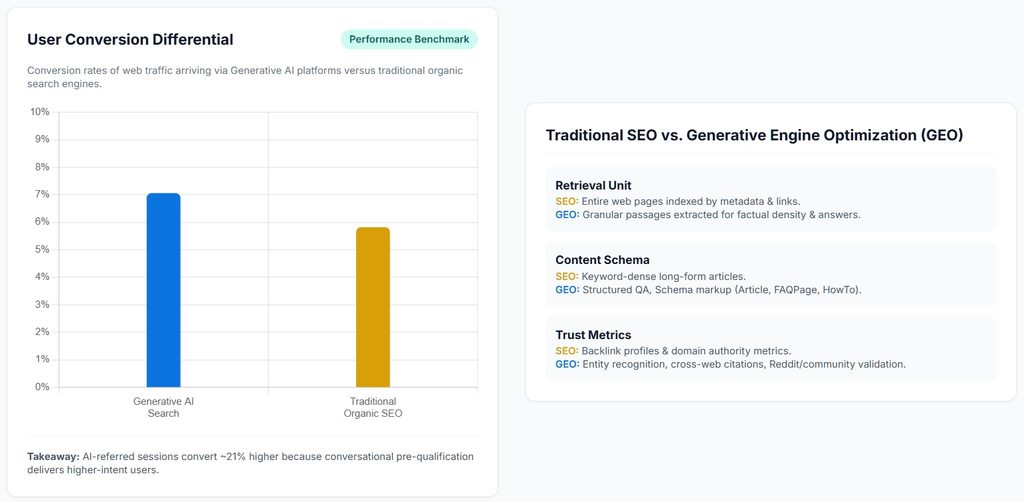
This has led to growing interest in terms such as Generative Engine Optimization (GEO) and Answer Engine Optimization (AEO).
The basic objective is to make a business’s information useful, understandable and credible enough to be surfaced when AI-powered search systems generate answers.
However, GEO should not be treated as a completely separate replacement for SEO.
Current guidance for Google’s AI search experiences explicitly states that established SEO best practices remain foundational. Google also emphasizes useful, original, people-first content rather than special tricks designed specifically to manipulate AI-generated answers. Google’s guidance on optimizing for generative AI search
This means businesses should focus on fundamentals such as:
Clear and useful content
Accurate information
Strong topical coverage
Logical website structure
Crawlable pages
Good user experience
Relevant internal links
Structured data where appropriate
Credible authorship and expertise
Consistent business information
Genuine third-party mentions and references
The goal is not to create content “for AI.”
The goal is to create such useful and well-structured information that both people and search systems can understand it.
Google’s current guidance also makes clear that there are no separate technical requirements or secret optimizations required to appear in AI Overviews or AI Mode beyond being eligible for Google Search and following established best practices. Google’s guide to AI features and websites
How AI Is Changing Search Visibility
Traditional search can be thought of as:
Query → Search engine → Ranked webpages → User chooses a result
Generative search increasingly introduces another layer:
Query → Retrieval → AI synthesis → Answer with supporting sources
This changes what visibility can mean.
A business may want to:
Rank for relevant searches
Appear in local results
Be referenced in AI-generated answers
Have its products or services understood correctly
Establish a recognizable entity and reputation
Become a trusted source of information
This makes the quality and consistency of a company’s digital presence increasingly important.
Google has also begun introducing dedicated reporting for visibility from generative AI features in Search Console, showing how AI search visibility is becoming part of the broader search ecosystem. Google’s announcement on generative AI performance reporting in Search Console
How to Create a Digital Marketing Strategy
A digital marketing strategy should begin with the business, not with a list of platforms.
1. Define the business objective
Start by deciding what marketing needs to accomplish.
Examples include:
Generate more enquiries
Increase online sales
Enter a new market
Increase local visibility
Build brand awareness
Reduce customer acquisition costs
Generate qualified B2B leads
Increase repeat purchases
A strategy without a clear objective can quickly become a collection of activities without a measurable outcome.
2. Identify your target audience
Understand:
Who your ideal customer is
What problem they are trying to solve
What they search for
Where they spend time online
What influences their decision
What objections they have
What alternatives they consider
The more clearly you understand the customer, the easier it becomes to choose appropriate channels and messaging.
3. Understand search and buying intent
Not every person searching for information is ready to buy.
Someone searching for:
“What is digital marketing?”
has informational intent.
Someone searching for:
“digital marketing agency in Bangalore”
has much stronger commercial intent.
Someone searching for:
“hire digital marketing agency Bangalore”
may have even stronger transactional intent.
Understanding this distinction helps businesses create the right content and campaigns for each stage of the buying journey.
4. Build a strong digital foundation
Your website is often the central asset connecting your digital marketing activities.
It should clearly communicate:
What you offer
Who you help
Why customers should choose you
What makes you different
What evidence supports your claims
How customers can contact you
Technical foundations matter as well. Search engines need to be able to crawl, understand and index your content, while users need a website that works properly across devices and provides a good experience. Google’s technical SEO guidance
5. Choose the right channels
You do not need to use every digital marketing channel.
Choose the channels that align with:
Customer behaviour
Business objectives
Sales cycle
Available resources
Geographic market
Competition
Budget
A local service business may benefit more from local SEO, Google Ads, reviews and WhatsApp than from trying to maintain six social media accounts.
A D2C brand may place greater emphasis on social media, creators, paid advertising, content and email.
A B2B manufacturer may need SEO, technical content, LinkedIn, paid search, case studies and lead nurturing.
6. Create useful content
Content should be created around real customer questions, problems and decisions.
Instead of asking:
“What should we publish this month?”
ask:
“What does our potential customer need to know before they choose us?”
This shift produces much more useful content.
7. Make conversion easy
Every major marketing channel should lead somewhere useful.
If someone arrives through an advertisement, can they quickly understand the offer?
If someone reads an article, can they easily find the relevant service?
If someone visits a product page, is it obvious what to do next?
If someone wants to speak with the company, can they contact it immediately?
Good marketing brings people to the door. Good conversion design makes it easy for them to walk through it.
8. Track meaningful results
Do not measure success solely through traffic, impressions or follower counts.
Connect marketing activity to business outcomes wherever possible.
For example:
Traffic → Leads → Qualified Leads → Sales → Revenue
This makes it easier to determine which activities are genuinely contributing to growth.
9. Test and improve
Digital marketing should operate as a continuous improvement cycle:
Plan → Launch → Measure → Learn → Optimize → Repeat
Campaigns, landing pages, content, offers and messaging can all be improved based on actual performance.
How Much Does Digital Marketing Cost in India?
There is no single price for digital marketing.
The cost depends on:
Business size
Industry
Competition
Geographic target
Number of channels
Content requirements
Website condition
Advertising budget
Lead volume
Level of strategy required
Agency or team structure
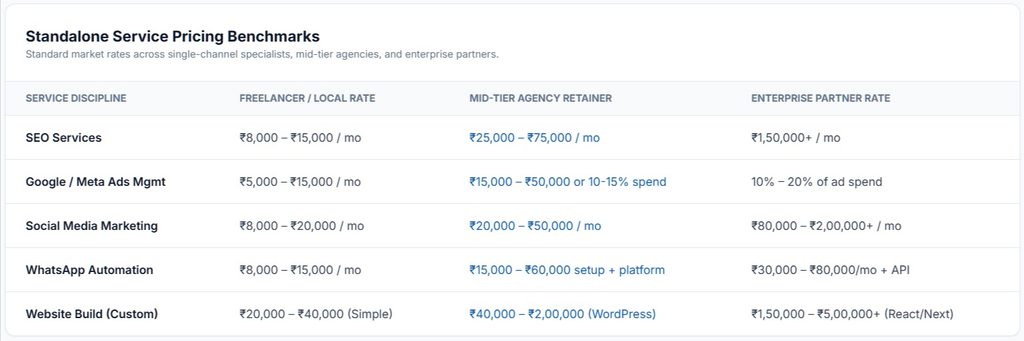
It is also important to distinguish marketing management costs from media or advertising spend.
For example, if an agency charges ₹50,000 per month to manage digital marketing, that does not necessarily mean ₹50,000 is being spent on advertising.
The business may separately pay Google, Meta, LinkedIn or another advertising platform for media spend.
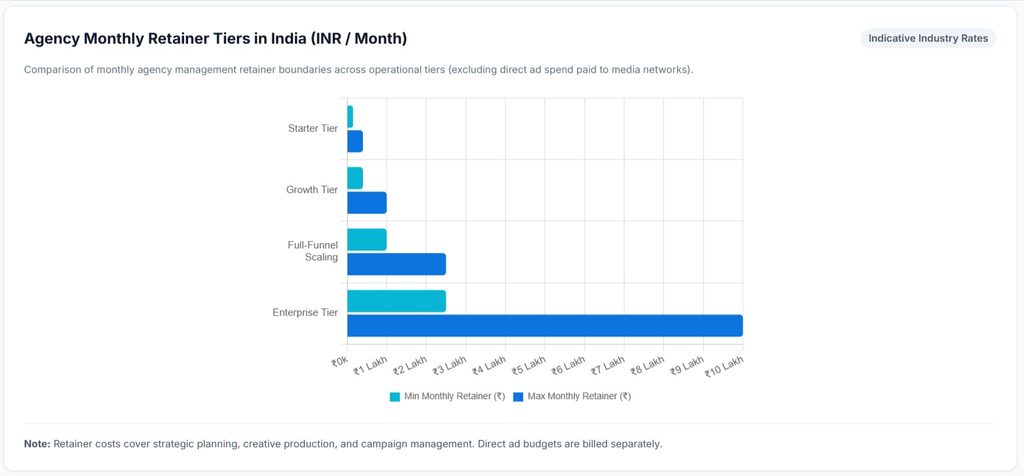
Typical digital marketing engagement models
Businesses can generally choose from four broad models:
| Model | Best suited for | Main advantage | Main limitation |
|---|---|---|---|
| Freelancer | Smaller or specialized requirements | Lower overhead | Limited breadth and capacity |
| Boutique agency | SMEs and focused growth | Specialist expertise | May have narrower service coverage |
| Full-service agency | Businesses needing multiple capabilities | Integrated execution | Higher investment |
| In-house team | Larger ongoing operations | Direct control | Recruitment and fixed costs |
The appropriate model depends on the complexity of the marketing operation rather than simply the size of the company.
A small business with a complex B2B sales process may need more strategic support than a larger company with a simple transactional product.
What Should Your Digital Marketing Budget Include?
A realistic budget may contain several separate components.
Strategy and management
This covers planning, campaign management, optimization, reporting and strategic work.
Advertising spend
This is the money paid to advertising platforms to display advertisements.
Content and creative production
This may include:
Articles
Photography
Video
Graphics
Landing pages
Social media content
Product creatives
Website and technical work
Web development, SEO implementation, analytics, tracking and conversion optimization may require separate investment.
Software and marketing technology
Depending on the business, this could include analytics, SEO tools, CRM software, email platforms, automation systems and other MarTech.
Initial setup
Businesses may also need one-time work such as:
Marketing audits
Analytics setup
Conversion tracking
Account configuration
Website technical audits
Audience research
Competitor research
Campaign setup
The important thing is to evaluate the total cost of achieving the business objective, rather than comparing agency retainers in isolation.
How Do You Measure Digital Marketing Success?
Different businesses should use different metrics, but the most useful measurements generally connect marketing activity to business outcomes.
Awareness metrics
Reach
Impressions
Brand searches
Video views
Social reach
Website and search metrics
Organic traffic
Search impressions
Search clicks
Rankings
Landing-page visits
Engagement
Lead-generation metrics
Enquiries
Form submissions
Calls
WhatsApp conversations
Qualified leads
Cost per lead
Sales metrics
Conversion rate
Customer acquisition cost
Revenue
Average order value
Return on ad spend
Customer lifetime value
Retention metrics
Repeat purchases
Email engagement
Customer retention
Churn
Referral activity
The most important metric is ultimately the one that connects marketing activity to the business outcome you are trying to improve.
A business focused on lead generation may care more about qualified leads and cost per acquisition than page views.
An e-commerce business may focus more heavily on revenue, conversion rate, average order value and customer lifetime value.
Common Digital Marketing Mistakes
Trying to be everywhere
Being active on every platform does not automatically produce better marketing.
It is usually better to perform exceptionally well on the channels that matter most to your customers.
Focusing on traffic instead of business results
Large amounts of irrelevant traffic are not necessarily valuable.
A smaller amount of highly qualified traffic can generate substantially more business.
Treating SEO as a one-time project
SEO requires ongoing improvement because competitors, customer behaviour, search results and websites continually change.
Creating content just to publish something
A large volume of generic content is not a substitute for useful information.
Google’s current guidance emphasizes original, useful, people-first content and warns against producing large amounts of low-value content primarily to manipulate search visibility. Google’s guidance on generative AI and website content
Expecting immediate results from every channel
Some channels can produce results quickly. Others, particularly organic search and content marketing, may take considerably longer to build momentum.
Businesses should set expectations according to the channel and the competitiveness of the market.
Ignoring the website
Sending more traffic to a poor website rarely solves the underlying problem.
If visitors cannot understand the offer, trust the business or take the next step easily, increasing traffic may simply increase wasted marketing spend.
Measuring vanity metrics
Followers, impressions and clicks can be useful indicators, but they should not become the ultimate measure of marketing success.
Treating AI as a replacement for strategy
AI can accelerate execution, but it does not replace customer understanding, positioning, creative judgment, business knowledge or accountability.
Using the same strategy for every business
A strategy that works for an e-commerce brand may be completely unsuitable for a manufacturer, school, law firm, restaurant or B2B technology company.
Digital marketing should be built around the business model and customer journey.
Is Digital Marketing Only for Online Businesses?
No.
Digital marketing can be valuable for almost any business, including companies that operate primarily offline.
A local restaurant can use digital marketing to generate reservations.
A school can use it to generate admissions enquiries.
A manufacturer can use SEO and content to reach procurement teams.
A healthcare business can use search visibility and educational content to help prospective patients discover its services.
A real estate company can use digital advertising, content and lead nurturing to generate property enquiries.
A professional services firm can use thought leadership and search visibility to build credibility before a prospect ever speaks to a salesperson.
The important question is not whether the business operates online.
The question is whether its customers use digital channels to discover, research, compare, communicate or make decisions about the business.
Digital Marketing for Small Businesses
Digital marketing can be particularly powerful for small and medium-sized businesses because it can provide access to audiences that were once difficult or expensive to reach.
A small business does not necessarily need the marketing budget of a national company to compete.
It may instead compete through:
Local search visibility
Specialist expertise
High-quality content
Strong reviews
Niche targeting
Better customer experience
Faster communication
Strong community relationships
Digital advertising and content distribution can also allow businesses to test ideas on a relatively small scale before committing larger budgets.
Recent Indian industry research highlights the importance of smaller and long-tail advertisers in digital advertising, with SMEs and other long-tail advertisers contributing significantly to digital ad spend.
Digital Marketing and Data Privacy
Modern digital marketing increasingly depends on customer data, which makes responsible data handling essential.
Businesses may collect information through:
Website forms
Account registrations
Purchases
Analytics
Marketing subscriptions
Customer support
Advertising systems
Mobile applications
Businesses operating in India also need to consider the country’s evolving data protection framework, including the Digital Personal Data Protection Act and associated rules.
The government has published the Digital Personal Data Protection Rules and related enforcement information through its official policy resources. India’s Digital Personal Data Protection Rules and enforcement resources
Marketing teams should therefore work closely with their legal, technology and compliance teams when collecting and using personal data.
Privacy should not be treated merely as a legal checkbox. Clear data practices can also help build customer trust.
The Future of Digital Marketing
Digital marketing will continue to evolve as technology and customer behaviour change.
Several developments are already reshaping the discipline.
Search is becoming more conversational
People are increasingly asking longer and more complex questions rather than relying only on short keyword searches.
Businesses therefore need content that addresses topics, problems and intent rather than simply targeting isolated keywords.
AI is becoming part of everyday marketing operations
AI will increasingly assist with research, analysis, personalization, automation, customer service and campaign optimization.
The competitive advantage will increasingly come from knowing where AI can improve efficiency and where human judgment remains essential.
Digital and physical experiences are converging
Digital marketing does not exist separately from the physical world.
Customers may discover a product online, visit a store, speak with a salesperson, make a purchase through a mobile device and receive support through messaging.
The boundaries between online and offline marketing are therefore becoming less distinct.
Commerce is becoming more integrated with media
Advertising, content, product discovery and transactions are increasingly connected.
E-commerce platforms, social platforms, search engines, messaging systems and retail environments can all play a role in moving a customer from discovery to purchase.
Trust is becoming more important
As AI makes it easier to produce content and advertising at scale, businesses need stronger signals of credibility.
Original expertise, first-hand experience, transparent information, customer reviews, strong brands and trustworthy third-party references can become increasingly important.
What Makes a Good Digital Marketing Strategy?
A good digital marketing strategy is not defined by how many channels a business uses.
It is defined by how effectively those channels work together to achieve a business objective.
A strong strategy should:
Start with a clear business goal
Understand the target customer
Identify customer intent
Build a strong digital foundation
Select appropriate marketing channels
Create genuinely useful content
Make conversion easy
Track meaningful business metrics
Use data to improve performance
Adapt as customer behaviour changes
Most importantly, digital marketing should not be viewed simply as an expense for generating clicks or traffic.
It should be treated as an investment in visibility, customer acquisition, relationships and business growth.
Final Thoughts
Digital marketing has evolved from a collection of online promotional tactics into a central part of how modern businesses attract and serve customers.
SEO helps people discover businesses. Paid advertising captures existing demand. Social media and content build awareness and trust. Websites turn attention into action. Email and messaging nurture relationships. Analytics show what is working. AI is increasingly helping businesses automate, personalize and optimize these activities.
At the same time, the fundamentals remain remarkably consistent: understand your customer, communicate a compelling value proposition, provide useful information, make it easy to take action and continuously improve based on evidence.
The businesses that succeed with digital marketing are not necessarily those that use the most tools or spend the most money.
They are the ones that build a coherent digital presence around how their customers actually discover, evaluate, choose and interact with them.
